
Why Dysphagia Awareness Matters: Advancing Education, Early Recognition, and Person-Centered Care Beyond National Swallowing Disorders Month
Awareness is often the first step toward better health outcomes.
Throughout National Swallowing Disorders Month, organizations across the healthcare community worked to increase public understanding of dysphagia through education, advocacy, and community engagement. Lifemere was proud to support the National Foundation of Swallowing Disorders (NFOSD) as a sponsor of its interactive GERDLE campaign, an innovative educational initiative designed to increase awareness of swallowing disorders through daily learning and engagement.
While awareness campaigns may appear simple on the surface, they address a significant clinical challenge. Dysphagia remains one of the most prevalent yet underrecognized conditions affecting individuals living with neurological disease, head and neck cancer, stroke, Parkinson's disease, Alzheimer's disease, ALS, and medically complex conditions associated with aging. Despite affecting millions of individuals worldwide, dysphagia continues to be underdiagnosed, undertreated, and frequently misunderstood by patients, caregivers, and even healthcare providers outside of swallowing-focused specialties.
For neurologists, Speech-Language Pathologists, primary care physicians, GPs, rehabilitation professionals, nurses, and interdisciplinary healthcare teams, increasing dysphagia awareness represents far more than public education. It represents an opportunity to improve earlier recognition, facilitate timely referral, reduce preventable complications, and ultimately support better long-term health outcomes.
The Global Burden of Dysphagia
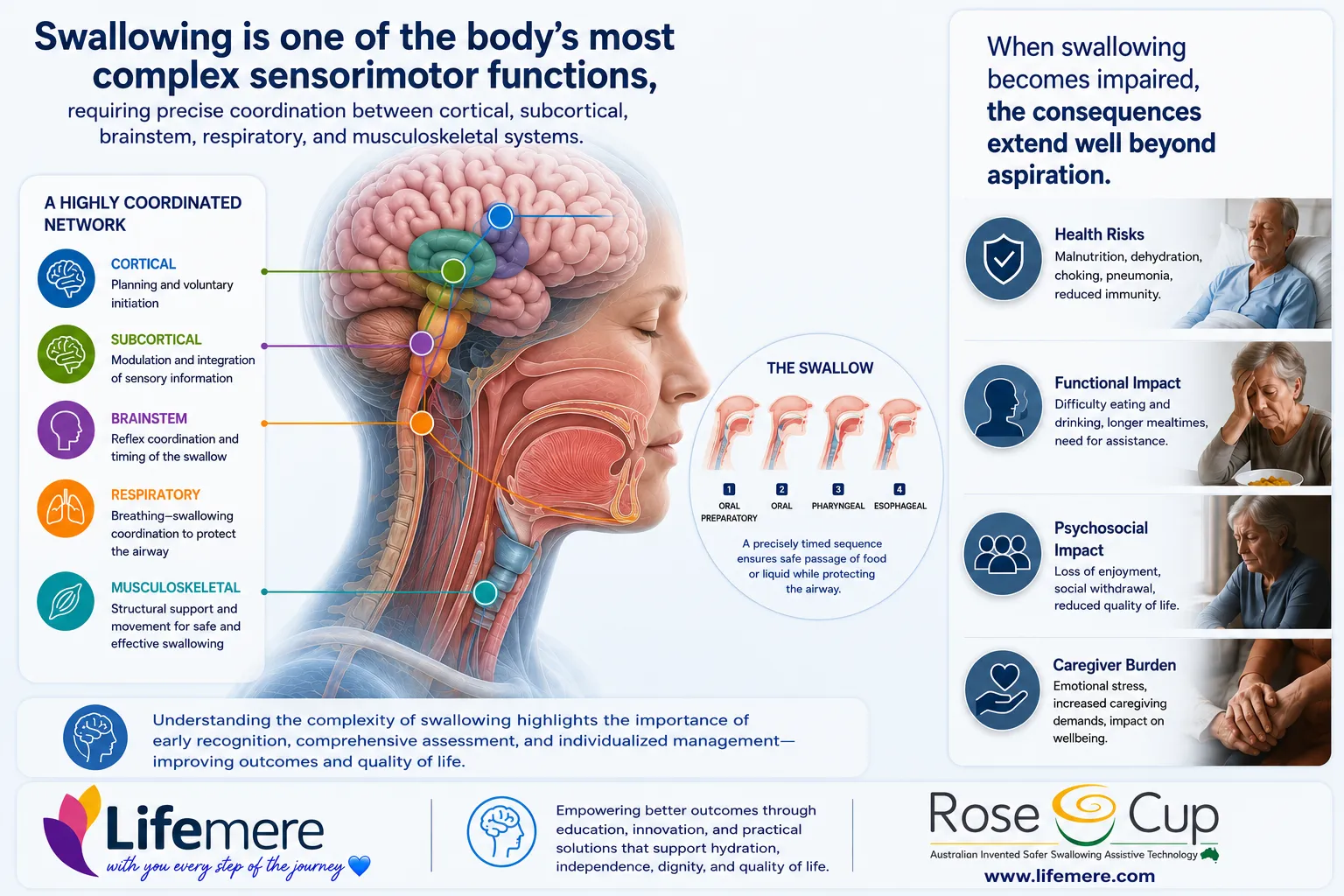
Swallowing is one of the body's most complex sensorimotor functions, requiring precise coordination between cortical, subcortical, brainstem, respiratory, and musculoskeletal systems. When swallowing becomes impaired, the consequences extend well beyond aspiration.
Individuals living with dysphagia frequently experience:
- dehydration
- malnutrition
- medication administration difficulties
- prolonged mealtimes
- reduced social participation
- anxiety surrounding eating and drinking
- caregiver burden
- increased hospitalization
- reduced quality of life
Recent literature continues to reinforce that dysphagia should be viewed as a multifactorial health condition affecting physical, nutritional, psychological, and social wellbeing rather than solely a disorder of airway protection. Source: Cordier R, Joosten A, Clavé P, et al. Dysphagia Management and Quality of Life: Current Perspectives. Dysphagia.
Similarly, the 2023 Clinical Practice Guidelines for Oropharyngeal Dysphagia emphasized the importance of early identification and multidisciplinary management to reduce complications associated with swallowing disorders. Source: Clinical Practice Guidelines for Oropharyngeal Dysphagia. Annals of Rehabilitation Medicine. 2023.
Why Public Awareness Influences Clinical Outcomes
Awareness is not simply about recognition. It influences behavior. Research consistently demonstrates that improved health literacy contributes to earlier healthcare utilization, improved adherence to treatment recommendations, and greater patient engagement in disease management.
For dysphagia, awareness may encourage individuals and caregivers to recognize early warning signs, including:
- coughing during meals
- unexplained weight loss
- prolonged mealtimes
- recurrent chest infections
- food sticking
- reduced fluid intake
- avoidance of eating with others
Earlier recognition allows for earlier referral to Speech-Language Pathologists and more timely implementation of evidence-based management strategies before preventable complications develop.
Bridging the Gap Between Clinical Recommendations and Everyday Life
One of the greatest challenges in dysphagia management occurs after assessment. Speech-Language Pathologists routinely provide individualized recommendations regarding swallowing strategies, diet modification, positioning, pacing, and hydration.
However, successful implementation depends upon practical, evidence-informed solutions that patients and caregivers can integrate into everyday routines. This implementation gap continues to receive increasing attention within person-centered models of dysphagia care.
Maintaining hydration, supporting self-feeding independence, reducing caregiver burden, and preserving participation during meals have become meaningful functional outcomes alongside aspiration prevention.
The Role of Assistive Technology in Supporting Functional Swallowing
Despite remarkable advances in instrumental assessment, rehabilitation, and interdisciplinary care, assistive technology remains comparatively underrepresented within dysphagia education.
Adaptive intake systems represent an evolving category of assistive technology designed to help support implementation of clinical recommendations outside the therapy environment.
The RoseCup® System is a comprehensive adaptive intake system intended to support more controlled fluid intake for individuals living with dysphagia, neurological conditions, upper extremity impairments, and age-related swallowing changes.
Through configurable flow control, interchangeable drinking supports, multiple handle configurations, and reduced need for excessive head tilt, the RoseCup® System may help support:
- hydration opportunities
- controlled bolus delivery
- self-feeding independence
- caregiver efficiency
- adherence to individualized swallowing recommendations
- person-centered participation during meals
Importantly, adaptive intake technologies are not intended to replace skilled swallowing assessment or intervention. Rather, they may help support accessibility and real-world implementation of evidence-based clinical recommendations.
Looking Beyond Awareness Months
National awareness campaigns create valuable opportunities to educate patients, caregivers, clinicians, and the broader community. However, meaningful progress requires sustained education long after awareness months conclude.
At Lifemere, we believe improving outcomes for individuals living with dysphagia requires more than innovative products alone. It requires advancing clinical education, increasing health literacy, supporting interdisciplinary collaboration, and improving access to practical solutions that help individuals safely participate in one of life's most fundamental activities: eating and drinking.
Our sponsorship of the National Foundation of Swallowing Disorders' GERDLE initiative reflects our ongoing commitment to helping elevate conversations surrounding swallowing health, supporting evidence-informed dysphagia education, and increasing awareness of the practical tools available to help individuals maintain hydration, independence, dignity, and quality of life.
Jessica Ackerman, MS,CCC-SLP, is a Speech-Language Pathologist and dysphagia specialist with more than 25 years of experience in swallowing disorders, neurological rehabilitation, digital health, and healthcare innovation. As a clinical consultant to Lifemere, she is passionate about advancing person-centered dysphagia care through education, innovation, and practical solutions that support hydration, participation, independence, and quality of life.
Link to relevant articles:
- Dysphagia Management Beyond Diet Modification: Reframing Clinical Goals Toward Hydration, Participation, and Quality of Life
- Dysphagia Awareness Month 2026: Expanding the Conversation Beyond Aspiration to Functional Living and Assistive Technology
- National Hydration Day: Reframing Hydration as a Functional Outcome in Dysphagia and Neurological Care
The science of texture-modified foods and thickened
liquids has reached a point of excellence under the
leadership of the IDDSI (International Dysphagia Diet
Standardisation Initiative). The considerable efficiency
gap that remains in managing Dysphagia
lies in intake devices.
More than 10 companies worldwide manufacture intake
devices, but in some care sectors, more than 90% of
patients still use spoons and open cups!
Professionals and carers need education and training,
and the industry needs guidelines, research, and
stimulation to improve the design of intake devices.

Congratulations to the IDDSI launching for the first time in
Europe with its inaugural congress in Florence, Italy, on
February 27-28, 2025. It represents a significant milestone
in enhancing the quality of care for individuals with
swallowing difficulties in Europe.

Dr Gabriel Roux will represent Lifemere in Florencе.
Contact: gawie@lifemere.com or phone: +61 428 406 684
Frequently Asked Questions

-- / 5 average rating from -- reviews
We'd love to hear your thoughts!
Lorem ipsum dolor sit amet, consectetur adipiscing elit. Suspendisse varius enim in eros elementum tristique. Duis cursus, mi quis viverra ornare, eros dolor interdum nulla, ut commodo diam libero vitae erat. Aenean faucibus nibh et justo cursus id rutrum lorem imperdiet. Nunc ut sem vitae risus tristique posuere.
We'd love to hear your thoughts!
-- / 5 average rating from -- reviews
Lorem ipsum dolor sit amet, consectetur adipiscing elit. Suspendisse varius enim in eros elementum tristique. Duis cursus, mi quis viverra ornare, eros dolor interdum nulla, ut commodo diam libero vitae erat. Aenean faucibus nibh et justo cursus id rutrum lorem imperdiet. Nunc ut sem vitae risus tristique posuere. uis cursus, mi quis viverra ornare, eros dolor interdum nulla, ut commodo diam libero vitae era