
Communication Creates Possibility: The Seven Possibilities of Speech Pathology Week

From 23 to 29 August 2026, Speech Pathology Australia is celebrating Speech Pathology Week, the profession's leading national awareness campaign.
The 2026 theme is: "Communication creates possibility."
This week highlights the many ways speech pathologists help people connect, learn, grow, belong, choose, participate and thrive. Speech Pathology Australia also explicitly recognises swallowing as a core component of speech pathology practice, with speech pathologists supporting people experiencing difficulties with eating and drinking as well as communication.
For Lifemere, there is something particularly meaningful about this year's theme. Our goal is not simply to manage the journey. It is to thrive in the journey.
Because when we look closely at dysphagia management, possibility is also at the heart of what speech pathologists create.
The possibility to drink.
The possibility to choose.
The possibility to participate.
The possibility to maintain independence.
The possibility to preserve dignity.
And ultimately, the possibility to thrive the whole journey.
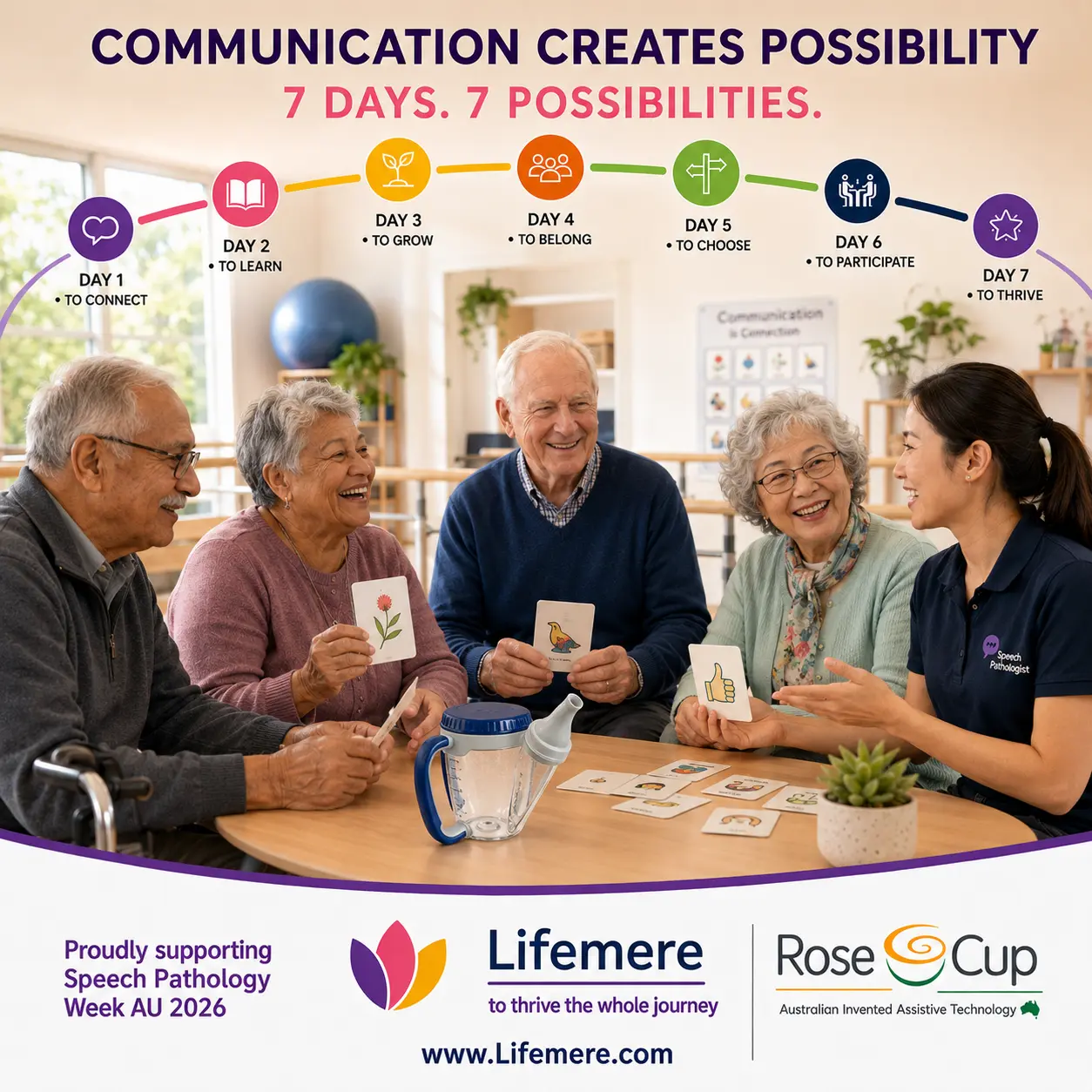
Day 1: Possibility to Connect
💫Connection is one of the most fundamental human needs.
For many people, eating and drinking are inherently social experiences. A morning coffee with a friend. A family meal. A drink at a community gathering. Sharing a cup of tea with a spouse. Sitting at the table with other residents in aged care.
Dysphagia can disrupt these seemingly ordinary moments.
When swallowing difficulties result in dietary restrictions, dependence on others, fear of aspiration, reduced confidence or difficulty managing drinks independently, the impact can extend well beyond the physiological act of swallowing.
This is one reason dysphagia management needs to consider the whole person and the whole mealtime experience.
A true person-centred approach emphasises understanding what matters to the individual, including their circumstances, needs and goals, rather than focusing solely on an impairment or diagnosis. That perspective is especially important when considering hydration.
A person's ability to access and consume fluids is influenced by much more than swallowing physiology. It can also be affected by cognition, upper-limb function, posture, fatigue, vision, mobility, environmental factors and the level of assistance available.
This means that supporting hydration may require a broader clinical conversation: Can this person access their drink? Can they physically manage the cup? Can they recognise and communicate when they want a drink? Can they drink in a way that aligns with their prescribed swallowing recommendations? Can they participate in the social experience of drinking with others?
These are questions that connect swallowing management with participation. And participation is possibility.
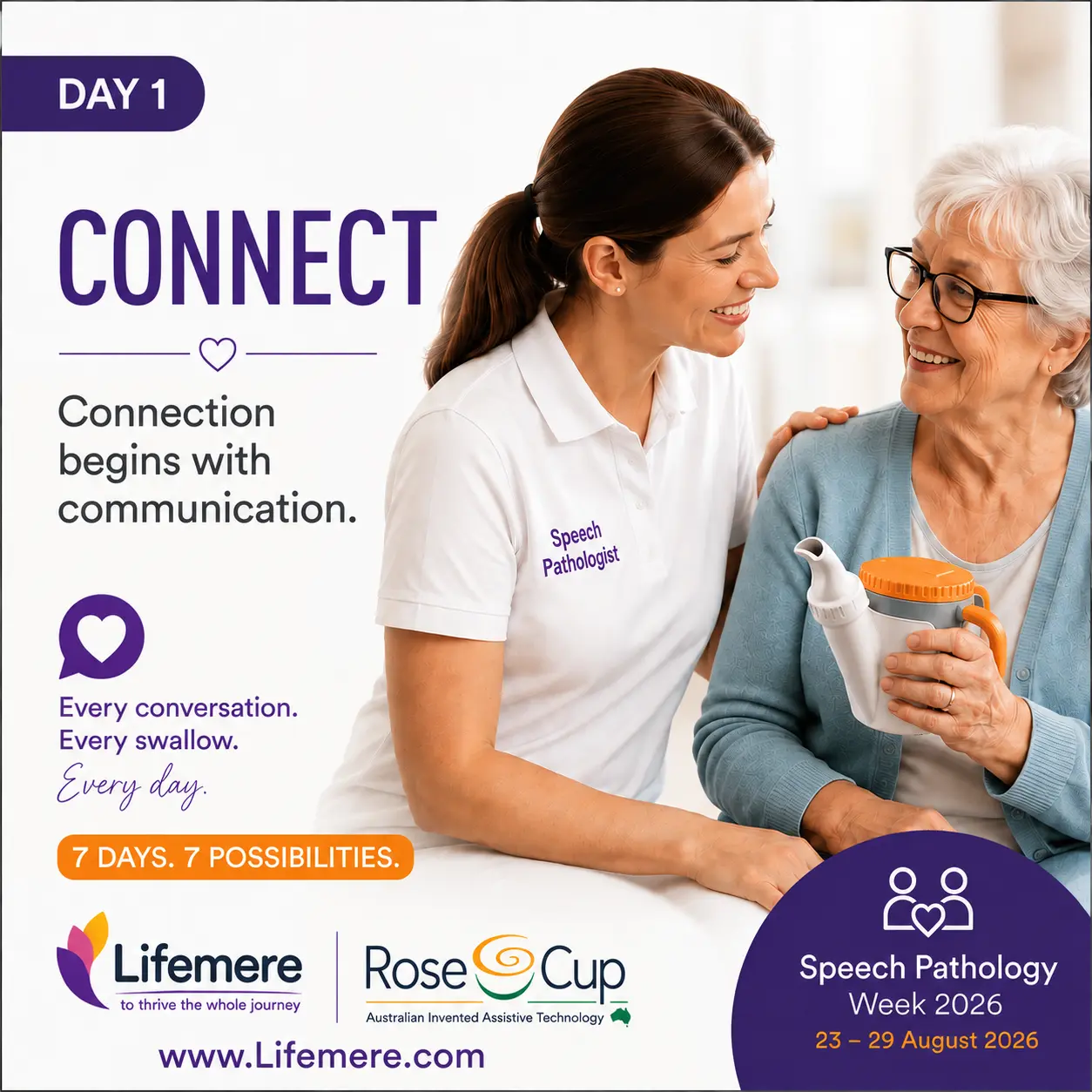
Day 2: Possibility to Learn
Every dysphagia assessment creates an opportunity to learn. Clinicians learn about the person's swallowing physiology, preferences, routines, environment and risks. But the person and their support network also learn. They may learn why particular strategies have been recommended, how to implement them, what signs to monitor and how to support safe and enjoyable eating and drinking.
Speech pathologists are specifically trained in the assessment, diagnosis and management of swallowing disorders and can provide individualised strategies, education and training for care partners, families and staff. This education becomes particularly important when recommendations affect everyday behaviours.
For example, texture modification and thickened fluids may be appropriate for some people, but their impact should be considered alongside factors such as hydration, adherence, preference and quality of life.
A systematic review examining the lived experience of oropharyngeal dysphagia found that bolus modification was generally associated with poorer health-related quality of life, although the evidence base and individual circumstances vary.
Similarly, evidence-based guidance on texture-modified foods and thickened liquids has highlighted the importance of considering outcomes beyond aspiration, including dehydration, weight loss, mealtime performance, preferences, adherence and quality of life.
This does not mean that texture modification should be abandoned. It means that clinical decisions should be individualised and proportionate.
The question becomes not simply:
What modification can we prescribe?
But:
What intervention provides the best balance of clinical safety, hydration, nutrition, preference, participation and quality of life for this person?
That is a more complex question.
And it is exactly why clinical expertise matters.
Day 3: Possibility to Grow
Growth does not always mean recovery.
For someone living with a progressive neurological condition, chronic disability or long-term swallowing impairment, growth may look very different.
It may mean developing greater confidence.
Finding a strategy that makes drinking more manageable.
Learning how to communicate preferences.
Increasing participation in mealtimes.
Maintaining independence for longer.
Or adapting to changing abilities while preserving the person's sense of self.
Dysphagia can have significant consequences for health and quality of life, particularly when it contributes to inadequate food or fluid intake. Recent systematic review evidence has also identified an association between dysphagia and activities of daily living among older adults, reinforcing that swallowing difficulties can intersect with broader functional independence.
This is where the concept of functional outcomes becomes so important. A swallowing intervention may be clinically appropriate, but its real-world value depends partly on whether the person can actually use it in everyday life.
For example, a recommendation may be technically sound, but if the person cannot independently manipulate the required equipment, cannot access fluids easily or requires more assistance than is realistically available, implementation may be difficult.
Assistive technology offers another way to think about this problem. Rather than asking only: "What does the person need help with?", we can also ask: "What could help the person do more for themselves?" That shift can be powerful.
The RoseCup® System is designed as an assistive drinking solution intended to support accessibility and independence for people who experience challenges with conventional drinking vessels. Within an appropriate clinical plan, assistive technology may provide another tool for clinicians considering how an individual can access fluids in a way that aligns with their abilities and recommendations.
Day 4: Possibility to Belong
Belonging can be lost quietly.
A person may stop attending social events because eating and drinking feel difficult. They may avoid restaurants because they are uncomfortable with their dietary requirements. They may feel embarrassed when they need assistance. They may withdraw from shared meals. Or they may simply stop asking for a drink because they do not want to burden someone else.
These experiences are rarely captured by a swallow study alone. Yet they matter. We always want to emphasise the importance of considering the individual at the centre of care and recognising what the person wants to achieve.
For clinicians, this creates an important opportunity to ask questions that extend beyond swallowing physiology:
- What does mealtime mean to this person?
- Where do they normally eat and drink?
- Who do they eat with?
- What activities have they stopped doing?
- How much assistance do they want?
- What choices are important to them?
- What would make eating and drinking feel more normal?
- Are there cultural or family practices that should be incorporated into care?
These questions can reveal goals that might otherwise remain invisible. Because a successful dysphagia intervention is not necessarily the one that produces the most restrictive plan. It is the one that appropriately balances risk, benefit, preference and participation for that individual.
Day 5: Possibility to Choose
Choice is fundamental to person-centred care.
For people living with dysphagia, however, choices can become increasingly constrained. What can I eat? What can I drink? When can I drink? Who needs to help me? Can I have water? Can I drink independently? Can I attend this event? Can I eat with my family? Can I decide what matters most to me?
Speech Pathology Australia's position statement on risk feeding recognises the role of speech pathologists in supporting informed choice and decision-making for people with dysphagia, including people who choose to eat or drink at risk. This is an important reminder that dysphagia management is not simply a technical exercise. It involves communication. It involves education. It involves shared decision-making. And it involves understanding the individual's values and priorities.
Research surrounding hydration and free water protocols also demonstrates why blanket approaches can be problematic. In carefully selected people with dysphagia, research has found that appropriately implemented free water protocols can be associated with increased fluid intake and improved swallow-related quality of life, without an observed increase in lung complications in the studied populations.
Importantly, these findings do not mean that unrestricted water is appropriate for everyone with dysphagia. They reinforce the importance of careful patient selection, clinical assessment and appropriate protocols. In other words: Choice does not mean abandoning clinical judgement. It means using clinical expertise to help people make informed choices wherever possible.
Day 6: Possibility to Participate
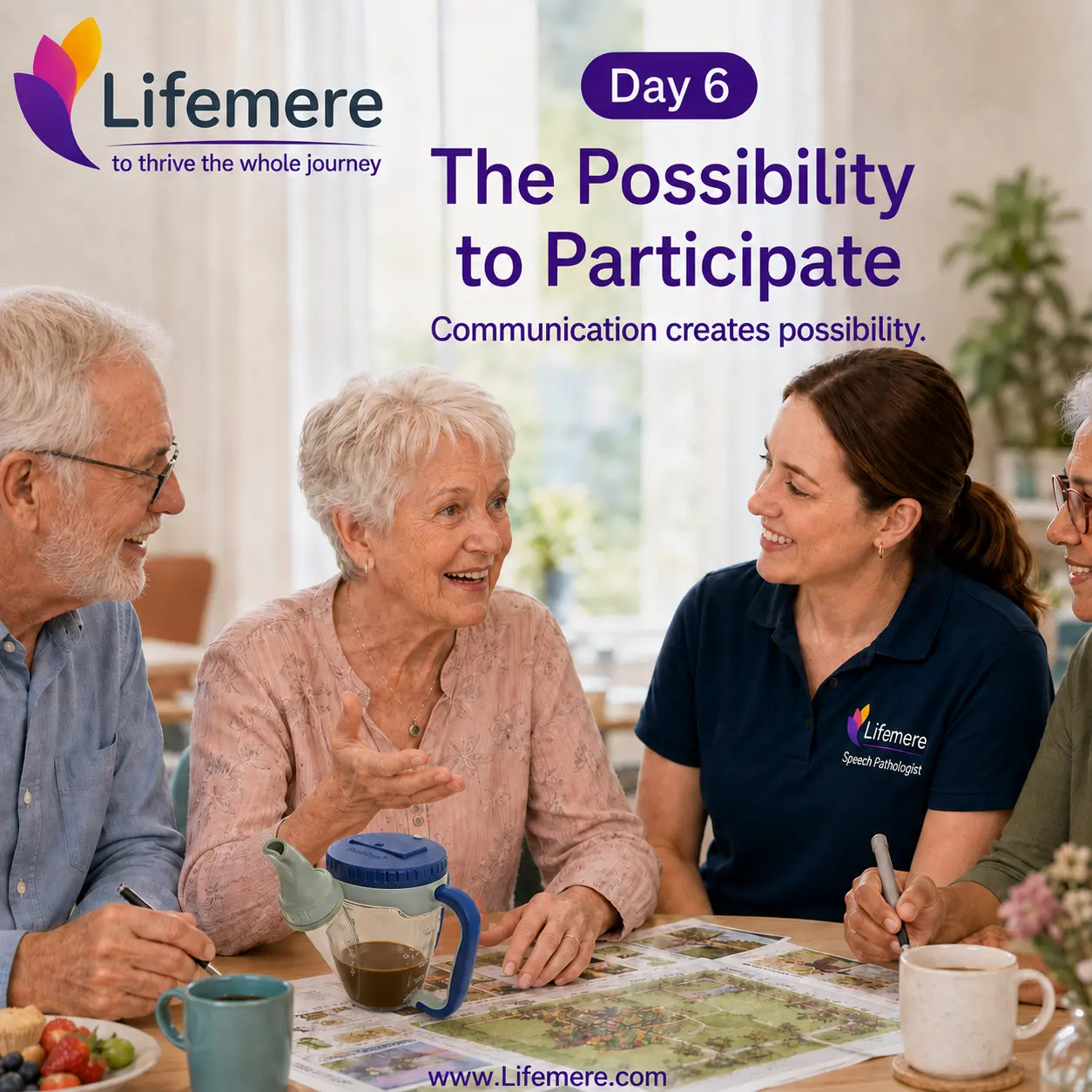
Participation is where clinical recommendations meet real life.
A person may demonstrate an improvement in swallowing function during an assessment, but what happens at breakfast? At lunch? At home? In hospital? In residential aged care? At a family gathering?
The ability to participate in everyday eating and drinking routines can be influenced by physical, cognitive, environmental and social factors. Hydration is a particularly important example. Dehydration is common among older adults, and systematic review evidence has linked dehydration with important health outcomes and healthcare considerations.
A systematic review and meta-analysis of hydration interventions in older adults found that behavioural interventions were associated with improved hydration, while the overall evidence for different intervention approaches was mixed. The meta-analysis found greater fluid consumption among intervention groups compared with usual care, although the authors emphasised the need for higher-quality research.
The implication for clinicians is important: Hydration cannot always be solved by simply telling someone to drink more.
The clinical team may need to consider:
- swallowing safety
- fluid consistency
- cognition
- access to drinks
- physical ability
- positioning
- fatigue
- frequency of offering fluids
- caregiver support
- preferences
- environment
- equipment
- cultural practices
- and the person's own goals
This is where multidisciplinary care becomes particularly valuable. Speech pathologists, dietitians, nurses, occupational therapists, physiotherapists, physicians, care staff, families and the person themselves may all contribute different perspectives. The goal is not simply to prescribe hydration. It is to make hydration achievable within the person's real life.
Day 7: Possibility to Thrive
This is where Speech Pathology Week's 2026 theme resonates particularly strongly with Lifemere. Because Lifemere's philosophy is:
To thrive the whole journey.
Thriving does not require perfection.
It does not require the complete resolution of a swallowing disorder.
And it certainly cannot be reduced to a single clinical outcome.
For someone living with dysphagia, thriving may mean continuing to participate in family meals.
It may mean being able to drink more independently.
It may mean retaining dignity during a vulnerable part of daily life.
It may mean having a voice in decisions about food and fluids.
It may mean maintaining cultural and social traditions.
It may mean finding ways to adapt as abilities change.
And sometimes, thriving means simply having the right support at the right time. This is why assistive technology deserves a place within the broader dysphagia conversation. The purpose of assistive technology is not to replace clinical assessment or intervention. It is to provide another potential tool for supporting function.
When appropriately selected and incorporated into a clinician-directed plan, an assistive drinking solution may help address the gap between what a person can do and what they need to do to participate in everyday life.
That gap can be particularly important for hydration.
The ESPEN guideline on clinical nutrition and hydration in geriatrics recommends that older people be considered at risk of low-intake dehydration and emphasises individualised, comprehensive and multidisciplinary approaches to nutrition and hydration.
This aligns closely with a broader understanding of dysphagia care. The goal is not simply to manage a swallow. The goal is to support the person living with the swallow.
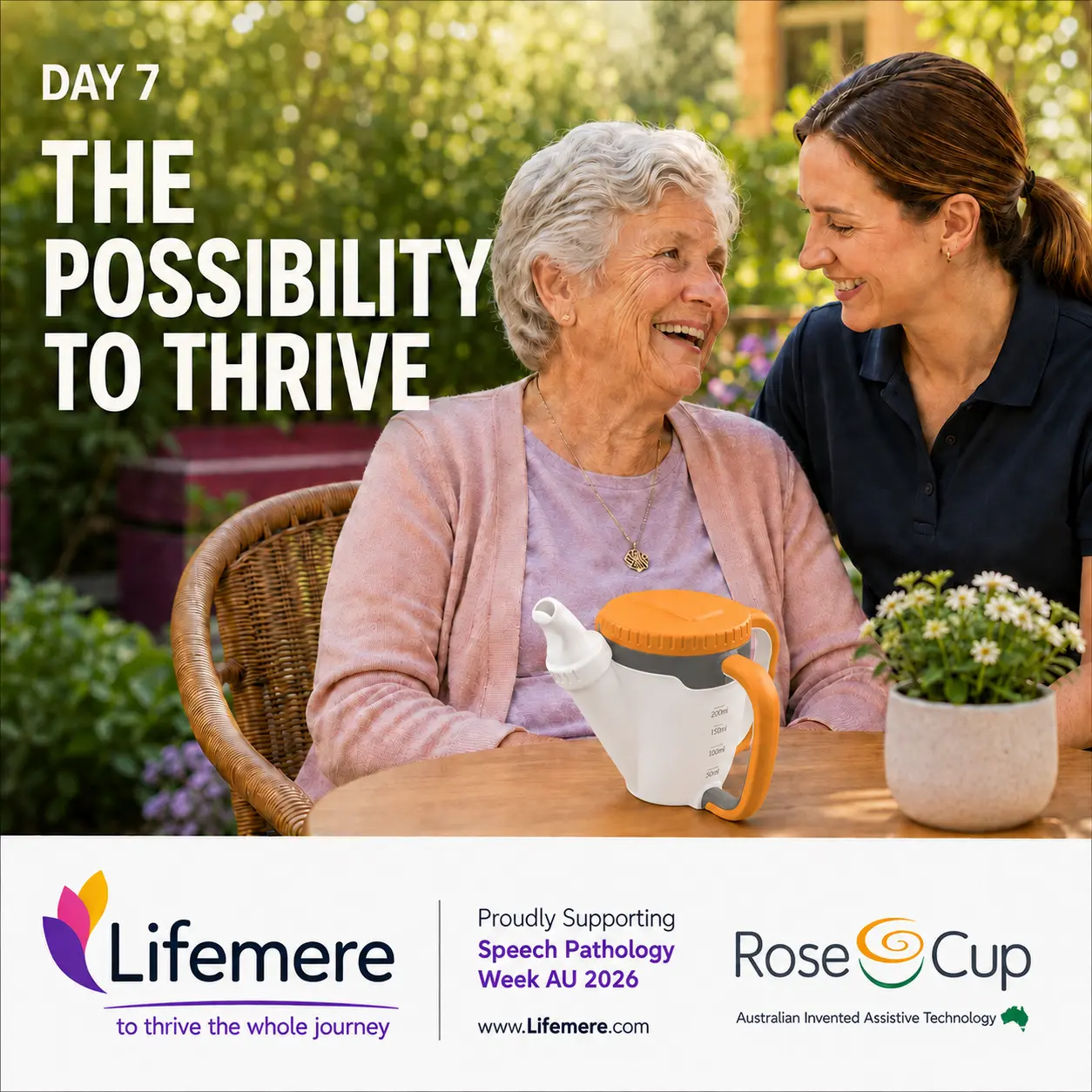
From Communication to Participation: Expanding the Dysphagia Conversation
Speech Pathology Week provides an important opportunity to broaden public understanding of what speech pathologists do. Speech pathologists are not simply professionals who help people speak. They work across communication, swallowing and eating and drinking support, in settings ranging from hospitals and rehabilitation services to residential aged care, community health, universities and private practice. And within dysphagia practice, their contribution extends well beyond identifying aspiration risk. Speech pathologists can help assess and manage swallowing difficulties, develop individualised strategies, educate people and their support networks, and contribute to decisions about eating, drinking and mealtime support.
This broader perspective matters because the consequences of dysphagia can reach into almost every aspect of daily life. Health. Hydration. Nutrition. Independence. Confidence. Social connection. Choice. Participation. Quality of life.
When these outcomes become part of the clinical conversation, dysphagia management becomes more than a question of what a person can safely swallow. It becomes a question of how we can support the person to live well with their swallowing difficulties.
Where Does Assistive Technology Fit?
For speech pathologists, assistive technology can be an important part of thinking beyond conventional interventions. The key is not the technology itself. The key is the functional problem it is intended to address.
For example, a person may understand their swallowing recommendations but struggle to drink independently because they cannot safely or effectively manipulate a conventional cup.
Another person may have sufficient upper-limb function but experience difficulty controlling the amount or flow of fluid.
Another may require a drinking solution that better accommodates their posture, mobility or functional limitations.
These are clinical questions. They require assessment. They require individualisation. And they require consideration of the person's preferences.
The RoseCup® System sits within this broader assistive technology conversation.
Rather than viewing a drinking vessel as simply a container for fluid, clinicians can consider whether the design of the drinking solution itself creates barriers or opportunities for independence. That is an important distinction.
Because sometimes the intervention is not about changing what a person drinks. It is about supporting how they access it.
A Clinician's Opportunity During Speech Pathology Week
Speech Pathology Week is a celebration of the profession. But it is also an opportunity to start conversations. For speech pathologists, that might mean asking: What possibility are we creating for this person?
Are we helping them connect?
Are we helping them learn?
Are we helping them grow?
Are we helping them belong?
Are we supporting informed choice?
Are we enabling participation?
And ultimately: Are we helping them thrive?
These questions can transform the way we think about outcomes. They move the conversation from impairment to function. From restriction to possibility. From dependence to supported independence. From a clinical recommendation to lived experience. And from managing a swallowing disorder to supporting a person's whole journey.
This Speech Pathology Week, Let's Celebrate What Speech Pathologists Make Possible
Speech Pathology Australia has chosen a powerful theme for 2026:Communication creates possibility.
For people living with dysphagia, that possibility can extend into some of the most ordinary and meaningful moments of everyday life. A drink with a friend. A meal with family. A choice made independently. A familiar cultural food. A shared celebration. A moment of connection. A little more confidence. A little more participation. A little more independence. These moments may seem small. But collectively, they are what make a life.
At Lifemere, we believe healthcare innovation should contribute to those moments. Because supporting hydration is not only about fluid intake. It can also be about dignity. It can be about independence. It can be about participation. It can be about choice. And ultimately, it can be about creating more possibilities for people living with swallowing difficulties.
This Speech Pathology Week, we celebrate the speech pathologists who create those possibilities every day. Because the goal is not simply to manage the journey.
It is to thrive the whole journey.
For Speech Pathologists
If you are a speech pathologist working with people experiencing dysphagia, hydration challenges or difficulties with independent drinking, Lifemere and the RoseCup® System provide another opportunity to consider how assistive technology may support accessibility and independence within an individualised clinical plan.
✨ Explore the broader conversation around dysphagia management, hydration and assistive technology through the Lifemere Dysphagia Blog. Explore the Living RoseCup® System with 15% off promo sale with code: NFOSD2026
Research & Clinical Resources
Speech Pathology Australia. Speech Pathology Week 2026: Communication Creates Possibility.
23 to 29 August 2026.
Speech Pathology Australia. What speech pathologists do.
Provides information about the role of speech pathologists in communication and swallowing, including the settings in which they work.
Speech Pathology Australia. Communication and swallowing/mealtime support needs.
Guidance describing the role of speech pathologists in assessment, management, individualised strategies, enjoyable mealtimes and education of care partners.
Speech Pathology Australia. Position Statement: Risk Feeding.
Addresses informed choice and decision-making for people with dysphagia, including people who elect to eat or drink at risk.
Gillman, A., et al. (2017). Implementing the Free Water Protocol does not Result in Aspiration Pneumonia in Carefully Selected Patients with Dysphagia: A Systematic Review. Dysphagia.
The review found low-quality evidence that carefully implemented protocols did not increase lung complications in selected rehabilitation populations and that fluid intake and swallow-related quality of life may improve.
Carrau, R., et al. / Free Water Protocol clinical trial.
Prospective research examining free access to water, hydration and quality of life in selected people with oropharyngeal dysphagia.
Speyer, R., et al. (2015). Living with oropharyngeal dysphagia: effects of bolus modification on health-related quality of life. Quality of Life Research.
Systematic review examining the relationship between bolus modification and health-related quality of life.
Beck, A. M., et al. (2018). Systematic review and evidence-based recommendations on texture modified foods and thickened liquids for adults with oropharyngeal dysphagia. Clinical Nutrition.
Reviews evidence relating to aspiration, pneumonia, dehydration, weight loss, preferences, adherence and quality of life.
Bruno, C., Collier, A., Holyday, M., & Lambert, K. (2021). Interventions to Improve Hydration in Older Adults: A Systematic Review and Meta-Analysis. Nutrients.
Reviews hydration interventions among older adults and identifies behavioural interventions as promising, while highlighting limitations in the evidence base.
El-Sharkawy, A. M., et al. / systematic review literature on dehydration in older adults.
Evidence concerning dehydration, health outcomes, healthcare costs and cognitive performance among older adults.
Volkert, D., et al. (2019). ESPEN guideline on clinical nutrition and hydration in geriatrics. Clinical Nutrition.
Provides evidence-based recommendations supporting individualised, comprehensive and multidisciplinary approaches to hydration and nutrition in older adults.
Jessica Ackerman, MS,CCC-SLP, is a Speech-Language Pathologist and dysphagia specialist with more than 25 years of experience in swallowing disorders, neurological rehabilitation, digital health, and healthcare innovation. As a clinical consultant to Lifemere, she is passionate about advancing person-centered dysphagia care through education, innovation, and practical solutions that support hydration, participation, independence, and quality of life.
Link to relevant articles:
- Dysphagia Management Beyond Diet Modification: Reframing Clinical Goals Toward Hydration, Participation, and Quality of Life
- Assistive Drinking Devices: From Recommendation to Reality Will the Liquid Intake Plan Work in Everyday Life?
- RoseCup® System: Understanding the Components & Clinical Applications. Plus August Exclusive 15% Savings
The science of texture-modified foods and thickened
liquids has reached a point of excellence under the
leadership of the IDDSI (International Dysphagia Diet
Standardisation Initiative). The considerable efficiency
gap that remains in managing Dysphagia
lies in intake devices.
More than 10 companies worldwide manufacture intake
devices, but in some care sectors, more than 90% of
patients still use spoons and open cups!
Professionals and carers need education and training,
and the industry needs guidelines, research, and
stimulation to improve the design of intake devices.

Congratulations to the IDDSI launching for the first time in
Europe with its inaugural congress in Florence, Italy, on
February 27-28, 2025. It represents a significant milestone
in enhancing the quality of care for individuals with
swallowing difficulties in Europe.

Dr Gabriel Roux will represent Lifemere in Florencе.
Contact: gawie@lifemere.com or phone: +61 428 406 684
Frequently Asked Questions

-- / 5 average rating from -- reviews
We'd love to hear your thoughts!
Lorem ipsum dolor sit amet, consectetur adipiscing elit. Suspendisse varius enim in eros elementum tristique. Duis cursus, mi quis viverra ornare, eros dolor interdum nulla, ut commodo diam libero vitae erat. Aenean faucibus nibh et justo cursus id rutrum lorem imperdiet. Nunc ut sem vitae risus tristique posuere.
We'd love to hear your thoughts!
-- / 5 average rating from -- reviews
Lorem ipsum dolor sit amet, consectetur adipiscing elit. Suspendisse varius enim in eros elementum tristique. Duis cursus, mi quis viverra ornare, eros dolor interdum nulla, ut commodo diam libero vitae erat. Aenean faucibus nibh et justo cursus id rutrum lorem imperdiet. Nunc ut sem vitae risus tristique posuere. uis cursus, mi quis viverra ornare, eros dolor interdum nulla, ut commodo diam libero vitae era