
RoseCup® System: Understanding the Components & Clinical Applications. Plus August Exclusive 15% Savings
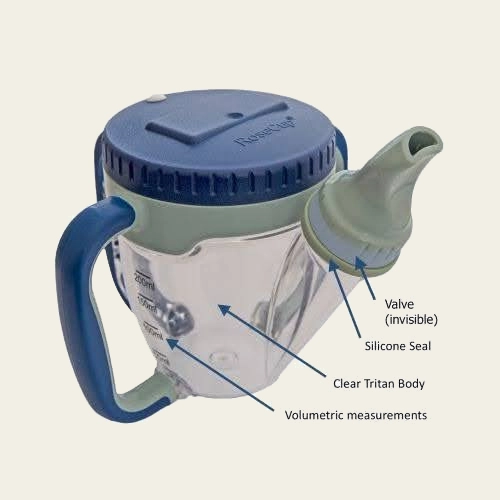
For clinicians managing dysphagia, the challenge is rarely simply identifying that a person needs an adaptation. The more clinically meaningful question is whether the adaptation can be individualized to the person's swallowing physiology, motor abilities, positioning, cognitive and sensory needs, preferences, and changing functional status.
The RoseCup® System was developed around this principle. Rather than functioning as a single-purpose adaptive cup, it is a modular drinking and intake system comprising a stable cup frame, interchangeable drinking attachments, flow-control options, and volume-control options. This allows clinicians and care teams to consider different configurations according to the individual's functional requirements.
The system was developed in Australia through ongoing testing, clinical feedback, and refinement, with the intention of providing adaptable options for people experiencing feeding and swallowing difficulties.
For a detailed overview of the system, see The RoseCup® System.
Key Clinical Takeaways
- The RoseCup® System is designed as a configurable intake system, rather than a single fixed drinking aid.
- Different attachments provide different approaches to flow control, delivery and, with the Soft Spouts, bolus volume control.
- The cup's handles, stable base and geometry are intended to support individuals with reduced dexterity, weakness, tremor or motor-control limitations.
- Attachment selection can be considered in relation to liquid consistency, positioning, functional capacity and the degree of assistance required.
- The system can be reconfigured as a person's abilities and clinical needs change.
- Device selection should remain part of individualized dysphagia management and should complement assessment and recommendations from qualified healthcare professionals.
Why the Design Matters Clinically
Dysphagia management frequently involves recommendations regarding liquid consistency, positioning, pacing, bolus size and method of delivery. Yet translating those recommendations into everyday intake can be challenging when the person also has impaired upper-extremity control, tremor, weakness, fatigue, reduced coordination, cognitive impairment or dependence on caregivers.
The RoseCup® System approaches this problem by separating the vessel itself from the method of delivery. The cup provides the foundation. The selected attachment then determines how liquid reaches the mouth and, depending on configuration, how flow or volume is regulated.
This distinction is clinically important because the same person may not require the same drinking configuration for every situation. A person may use one attachment during meals and another for beverages, or the optimal configuration may change as neurological or functional abilities change. The original RoseCup® is a "living system," with components intended to be adjusted as clinical circumstances and individual preferences evolve.
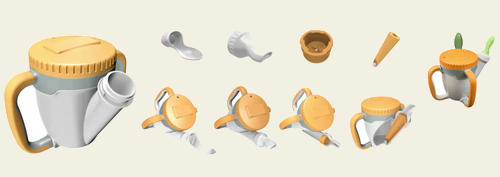
1. The RoseCup® Frame
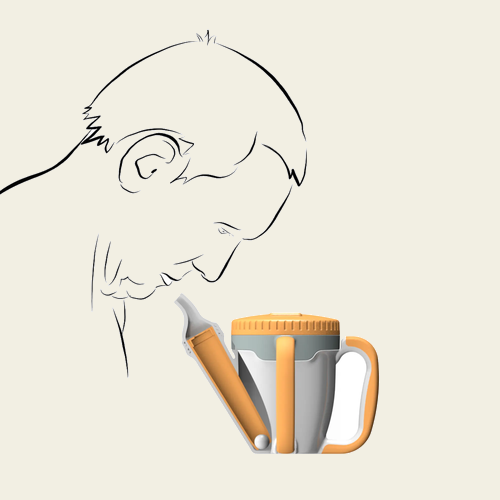
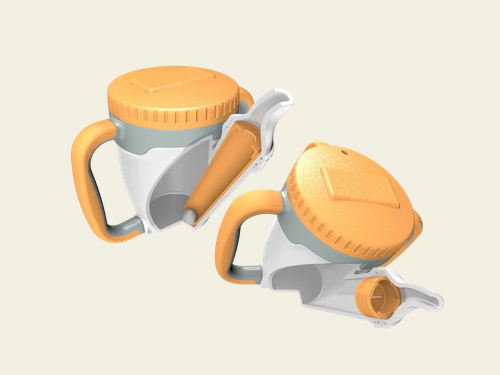
The cup is the foundation of the system. It has a 350 mL capacity, external volume markings, a liquid-tight screw-on lid, a stable base and multiple grasping options. Two side handles provide options for the user, while a rear handle can facilitate caregiver-assisted drinking. The tapered body and outlet geometry are designed to facilitate delivery without requiring excessive neck extension. This can be particularly relevant when clinicians are trying to maintain a prescribed or more functional head and neck position during drinking.
Clinical application
The frame may be considered when a conventional cup is difficult to grasp, stabilize, lift or position.
Potential clinical considerations include:
- reduced hand strength
- tremor
- impaired coordination
- unilateral upper-extremity weakness
- fatigue
- reduced fine-motor control
- need for caregiver assistance
- difficulty maintaining an optimal drinking position
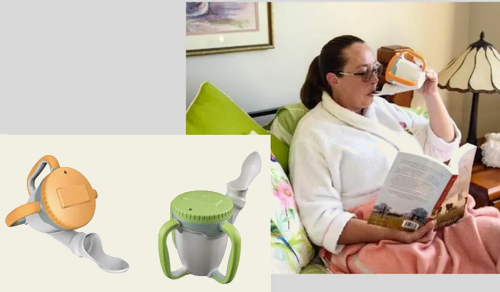
The system can be used in seated positions and, with appropriate attachment selection and clinical judgment, can also accommodate reclined intake. The objective is not simply to make a cup easier to hold. It is to create a stable platform from which the delivery method can be individualized.
2. The Modified Sipper Attachment
The Sipper is designed to provide a familiar drinking interface while accommodating thin liquids and thickened fluids. Its broad, curved outlet is designed around the adult oral opening, while the attachment connects directly to the RoseCup® frame.
Clinical application
The Sipper may be considered when a person can manage a conventional sipping action but requires a vessel that minimizes the need for excessive head tilt. It can be used at a table, in a chair or in bed in appropriate seated positioning. This is an option for lower-risk users because it does not independently provide volume control.
For individuals who require greater regulation of delivery, the Sipper can be paired with either the X-Valve or Straw Insert.
3. The Spoon Attachment
The Modified Spoon provides an alternative oral delivery method for individuals who may be more familiar or comfortable with spoon-based intake. The attachment incorporates a small gate that regulates the movement of Level 1 thickened fluid into the spoon. The spoon can then be sipped from in a controlled, familiar manner.
Clinical application
The Spoon may be particularly useful when introducing a person to an adaptive drinking system or when a spoon-based delivery method is already familiar. This configuration is primarily for Level 1 thickened fluids and lower-risk or earlier-stage dysphagia management. Clinically, the spoon attachment is helpful for bolus management and to reduce anterior bolus leakage. In addition, familiarity can matter. An adaptive device is only useful if the person will tolerate and engage with it, making the spoon an ideal option to ensure participation in intake to optimise hydration.
4. The Flow Control Valve
The X-Valve is a soft silicone valve positioned within the outlet channel beneath the Sipper attachment. Its function is straightforward: it introduces resistance to fluid flow. The X-Valve can therefore modify the rate at which fluid passes through the Sipper without changing the Sipper itself.
Clinical application
This configuration may be considered when a person can initiate drinking but requires a slower or more regulated flow for bolus management and to reduce anterior bolus leakage.
It can be particularly relevant when clinicians are considering:
- bolus control
- rate of delivery
- reduced risk of uncontrolled liquid flow
- a more manageable drinking pace
The X-Valve can be used with the three levels of thickened fluid identified by the IDDSI, and provides flow control rather than bolus-volume control.
5. The Straw Insert
The Straw Insert incorporates a small ball valve within a sealed chamber. With gentle sucking through the Sipper, fluid is drawn through the valve. When the sucking action stops, the ball valve closes, limiting continued flow.
Clinical application
This configuration offers another approach to flow management and can be useful when a person benefits from a straw-like drinking action with the neck in flexion (chin tuck posture) and can support low-effort intake against gravity. It can accommodate thin liquids and the three thickened-fluid levels. The Ball Valve provides flow control, not volume control.
6. The Soft Spouts
The Soft Spouts provide the RoseCup® System's most controlled method of liquid delivery, combining flow control with volume control. Each spout is designed for a specific thickened-liquid consistency and releases approximately 3 mL per suck cycle, helping limit continuous liquid flow.
The three Soft Spouts correspond to the following IDDSI drink levels and are color-coded to help match the attachment to the prescribed liquid consistency. :
- IDDSI Level 1, Slightly Thick: 0.5 mm spout opening (Green spout)
- IDDSI Level 2, Mildly Thick: 1.0 mm spout opening (Purple spout)
- IDDSI Level 3, Moderately Thick: 2.0 mm spout opening (Blue spout)
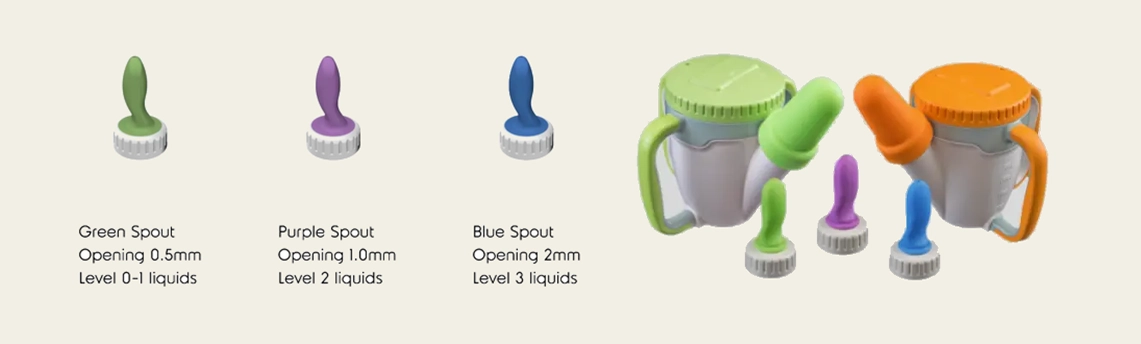
The spouts are color-coded to help match the attachment to the prescribed liquid consistency. Importantly, IDDSI Level 4 Extremely Thick is not represented by a dedicated Soft Spout. IDDSI terminology should be confirmed using the clinician's prescribed consistency and appropriate IDDSI testing procedures.
Clinical application
The Soft Spouts may be considered when an individual requires greater regulation of both flow and bolus volume, particularly when drinking thickened liquids. The user must generate sufficient oral and tongue action to activate the spout, making functional capacity an important consideration during clinical selection.
For clinicians, the key distinction is that the Soft Spout configuration allows the delivery method to be matched more specifically to the prescribed IDDSI consistency and the individual's ability to initiate and regulate intake, rather than relying on a conventional cup with an uncontrolled flow.
Matching the Configuration to the Clinical Problem
The value of an adaptive system lies in the ability to match the device to the person rather than asking the person to adapt to a fixed device.
A clinician might therefore consider:
Reduced grip or coordination: RoseCup® handles and stable base.
Difficulty with conventional cup positioning: The tapered frame and attachment configuration designed to minimize excessive head tilt.
Need for slower flow: Sipper with X-Valve or Straw Insert.
Need for regulated volume: Soft Spout configuration.
Preference for familiar spoon-based intake: Spoon attachment.
Need for monitoring intake: Clear RoseCup®.
Changing functional capacity: Reconfiguration of attachments rather than replacing the entire system.
This is particularly relevant in progressive neurological conditions. A person with Parkinson's disease may experience changes in tremor, bradykinesia, coordination and endurance. A person with ALS may require increasingly adaptive strategies as motor function changes. Following stroke, unilateral weakness, impaired coordination or cognitive-perceptual deficits may influence device selection.
The clinical question therefore becomes less about identifying the "best cup" and more about identifying the most appropriate configuration for this person, at this stage, for this task.
From Device Selection to Clinical Trial
The RoseCup® System should not be viewed as a replacement for dysphagia assessment or individualized clinical management. Instead, it can be incorporated into a structured clinical trial in which the clinician establishes the functional problem, selects an appropriate configuration, observes performance and measures meaningful outcomes.
Possible outcomes may include:
- volume of fluid consumed
- time required for drinking
- level of assistance
- spillage
- fatigue
- coughing or throat clearing
- user acceptance
- caregiver workload
- ability to maintain recommended positioning
- adherence across meals and beverages
This approach aligns with broader person-centered dysphagia management, where successful intervention extends beyond physiological safety to include hydration, nutrition, independence, participation and quality of life.
For clinicians working within the IDDSI Framework, attachment selection should also be considered alongside the prescribed food or fluid consistency and the individual's comprehensive swallowing assessment.
A Configurable System for Changing Needs
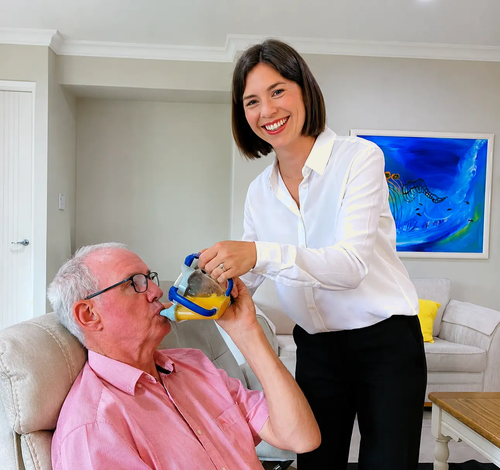
One of the fundamental design principles of the RoseCup® System is that the system does not have to remain static. The original development material describes a complete kit containing the cup, lid, multiple attachments, Soft Spouts, valves, cleaning equipment and related components, allowing clinicians to evaluate different configurations and then select the elements required by the individual.
That adaptability may be particularly valuable in neurological and medically complex populations, where function can change over days, months or years. An intervention that works today may not be optimal six months from now.
A configurable system allows the clinical team to reconsider the delivery method without necessarily abandoning the entire device.
Clinical Considerations and Safety
As with any assistive drinking technology, the RoseCup® System should be selected and used according to the individual's clinical circumstances and the manufacturer's instructions.
Please note that proposed physiological benefits associated with suck-initiated swallowing have not yet been validated by research.
Accordingly, clinicians should distinguish between:
what the device physically does,
what a particular configuration may help support functionally,
and what remains a clinical or research hypothesis.
That distinction is essential to responsible evidence-informed dysphagia practice.
An Invitation to Clinicians
For Speech-Language Pathologists, Occupational Therapists, physicians, nurses and other members of the interdisciplinary team, adaptive drinking technology represents an opportunity to address a part of dysphagia care that can be overlooked: how the clinical plan actually becomes daily behavior.
The RoseCup® System provides multiple configurations that can be trialled against the person's functional abilities, swallowing recommendations and preferences.
The goal is not simply to provide another cup.
It is to create an adaptable interface between clinical recommendations and real-world intake.
August Exclusive RoseCup® Promotion
For August, Lifemere is offering 15% off RoseCup® products with promo code:
NFOSD2026
This exclusive promotion is available through the Lifemere international shop.
To explore the full system, components and clinical applications, visit The RoseCup® System.
Key Clinical Takeaway
The clinical value of the RoseCup® System is its configurability. Rather than prescribing a single drinking method for every person with dysphagia, clinicians can consider the interaction between swallowing physiology, functional capacity, positioning, liquid consistency, flow, volume, independence and caregiver support, then trial the configuration that best fits the individual's needs.
About Lifemere
Lifemere is an Australian healthcare innovation company focused on supporting hydration, independence, participation and quality of life for individuals living with swallowing disorders and other conditions affecting intake. The RoseCup® is a registered Class 1 Medical Device with the Australian Therapeutic Goods Administration (TGA). Lifemere was also a proud 2025 sponsor of the International Dysphagia Diet Standardisation Initiative (IDDSI), supporting global awareness of standardized dysphagia terminology and testing.
Lifemere is now a preferred supplier for Australian Health and Aged Care (AHAC), expanding access to dysphagia solutions across Australia's healthcare and aged care sectors.
For information about the regulatory framework for medical devices in Australia, see the Therapeutic Goods Administration.
References and Further Reading
International Dysphagia Diet Standardisation Initiative (IDDSI). IDDSI Framework.
Lifemere. The RoseCup® System.
Lifemere. RoseCup® Products and Shop.
Therapeutic Goods Administration. Medical Devices Overview.
Steele CM, Greenwood C, Ens I, Robertson C, Seidman-Carlson R. Mealtime difficulties in a home for older people: not just dysphagia. Dysphagia. 1997;12:43-50.
Ibrahim JE, Bugeja L, Willoughby M, et al. Premature deaths of nursing home residents: an epidemiological analysis. Medical Journal of Australia. 2017;206(10):442-447.
Wham C, Fraser E, Buhs-Catterall J, et al. Malnutrition risk of older people across district health board community, hospital and residential care settings in New Zealand. Australasian Journal on Ageing. 2017.
Jessica Ackerman, MS,CCC-SLP, is a Speech-Language Pathologist and dysphagia specialist with more than 25 years of experience in swallowing disorders, neurological rehabilitation, digital health, and healthcare innovation. As a clinical consultant to Lifemere, she is passionate about advancing person-centered dysphagia care through education, innovation, and practical solutions that support hydration, participation, independence, and quality of life.
Link to relevant articles:
- Bridging the Gap Between Clinical Recommendations and Everyday Drinking: Why the RoseCup® System Deserves a Place in Contemporary Dysphagia Management
- Upcoming Webinar: Adaptive Drinking Systems as an Early Intervention Strategy
- Assistive Drinking Devices: From Recommendation to Reality Will the Liquid Intake Plan Work in Everyday Life?
The science of texture-modified foods and thickened
liquids has reached a point of excellence under the
leadership of the IDDSI (International Dysphagia Diet
Standardisation Initiative). The considerable efficiency
gap that remains in managing Dysphagia
lies in intake devices.
More than 10 companies worldwide manufacture intake
devices, but in some care sectors, more than 90% of
patients still use spoons and open cups!
Professionals and carers need education and training,
and the industry needs guidelines, research, and
stimulation to improve the design of intake devices.

Congratulations to the IDDSI launching for the first time in
Europe with its inaugural congress in Florence, Italy, on
February 27-28, 2025. It represents a significant milestone
in enhancing the quality of care for individuals with
swallowing difficulties in Europe.

Dr Gabriel Roux will represent Lifemere in Florencе.
Contact: gawie@lifemere.com or phone: +61 428 406 684
Frequently Asked Questions

-- / 5 average rating from -- reviews
We'd love to hear your thoughts!
Lorem ipsum dolor sit amet, consectetur adipiscing elit. Suspendisse varius enim in eros elementum tristique. Duis cursus, mi quis viverra ornare, eros dolor interdum nulla, ut commodo diam libero vitae erat. Aenean faucibus nibh et justo cursus id rutrum lorem imperdiet. Nunc ut sem vitae risus tristique posuere.
We'd love to hear your thoughts!
-- / 5 average rating from -- reviews
Lorem ipsum dolor sit amet, consectetur adipiscing elit. Suspendisse varius enim in eros elementum tristique. Duis cursus, mi quis viverra ornare, eros dolor interdum nulla, ut commodo diam libero vitae erat. Aenean faucibus nibh et justo cursus id rutrum lorem imperdiet. Nunc ut sem vitae risus tristique posuere. uis cursus, mi quis viverra ornare, eros dolor interdum nulla, ut commodo diam libero vitae era