
Bridging the Gap Between Clinical Recommendations and Everyday Drinking: Why the RoseCup® System Deserves a Place in Contemporary Dysphagia Management
For Speech-Language Pathologists, neurologists, primary care physicians, rehabilitation professionals, and interdisciplinary healthcare teams, dysphagia management extends well beyond the swallowing assessment. While instrumental evaluations and evidence-based interventions remain the foundation of care, the ultimate measure of success is whether an individual can safely and consistently implement clinical recommendations in everyday life.
This implementation gap is one of the greatest yet least discussed challenges in dysphagia management.
Patients may understand compensatory strategies, comply during therapy sessions, and demonstrate safe swallowing under supervised conditions. Yet once they return home, maintaining hydration, adhering to modified liquid recommendations, self-feeding independently, and participating in daily mealtimes often become significantly more difficult.
As clinicians continue shifting toward person-centered models of care, greater attention should be given to adaptive intake technologies that may help support the practical application of swallowing recommendations outside the clinical setting.
Looking Beyond Aspiration
Historically, dysphagia management has appropriately focused on aspiration prevention and pulmonary protection. However, recent literature increasingly recognizes that swallowing health also encompasses hydration, nutrition, medication management, participation, caregiver burden, and health-related quality of life.
The multinational consensus on dysphagia in Parkinson's disease emphasizes that swallowing surveillance should extend beyond aspiration detection to include earlier recognition of functional swallowing changes and proactive management strategies. Cosentino G, Avenali M, Schindler A, et al. A multinational consensus on dysphagia in Parkinson's disease: screening, diagnosis and prognostic value. Journal of Neurology. 2022.
Similarly, Mozzanica and colleagues demonstrated that reduced tongue strength and endurance were associated with poorer oral phase efficiency, reduced meal performance, and increased malnutrition risk in individuals living with Parkinson's disease, reinforcing the importance of evaluating functional swallowing outcomes in addition to aspiration risk. Mozzanica F, et al. Tongue strength and endurance in Parkinson's disease. Dysphagia. 2025.
Collectively, these studies support an evolving understanding of dysphagia management that prioritizes functional oral intake, hydration, participation, and quality of life alongside airway protection.
The Role of Assistive Technology
Despite remarkable advances in dysphagia assessment and rehabilitation, comparatively little attention has been given to adaptive intake systems that help patients implement swallowing recommendations throughout their daily routines.
For many individuals living with neurological disease, drinking from a conventional cup presents multiple challenges that extend beyond swallowing physiology.
These commonly include:
- reduced oral motor control
- tremor
- upper extremity weakness
- impaired hand coordination
- arthritis
- reduced cervical mobility
- fatigue
- caregiver dependence
- anxiety surrounding drinking
Even when swallowing recommendations are clinically appropriate, these functional barriers may contribute to reduced hydration, prolonged mealtimes, decreased independence, and lower adherence to prescribed compensatory strategies.
Adaptive intake systems should therefore be viewed not as simple drinking vessels, but as assistive technologies that may help support accessibility, independence, and person-centered participation.
Introducing the RoseCup® System
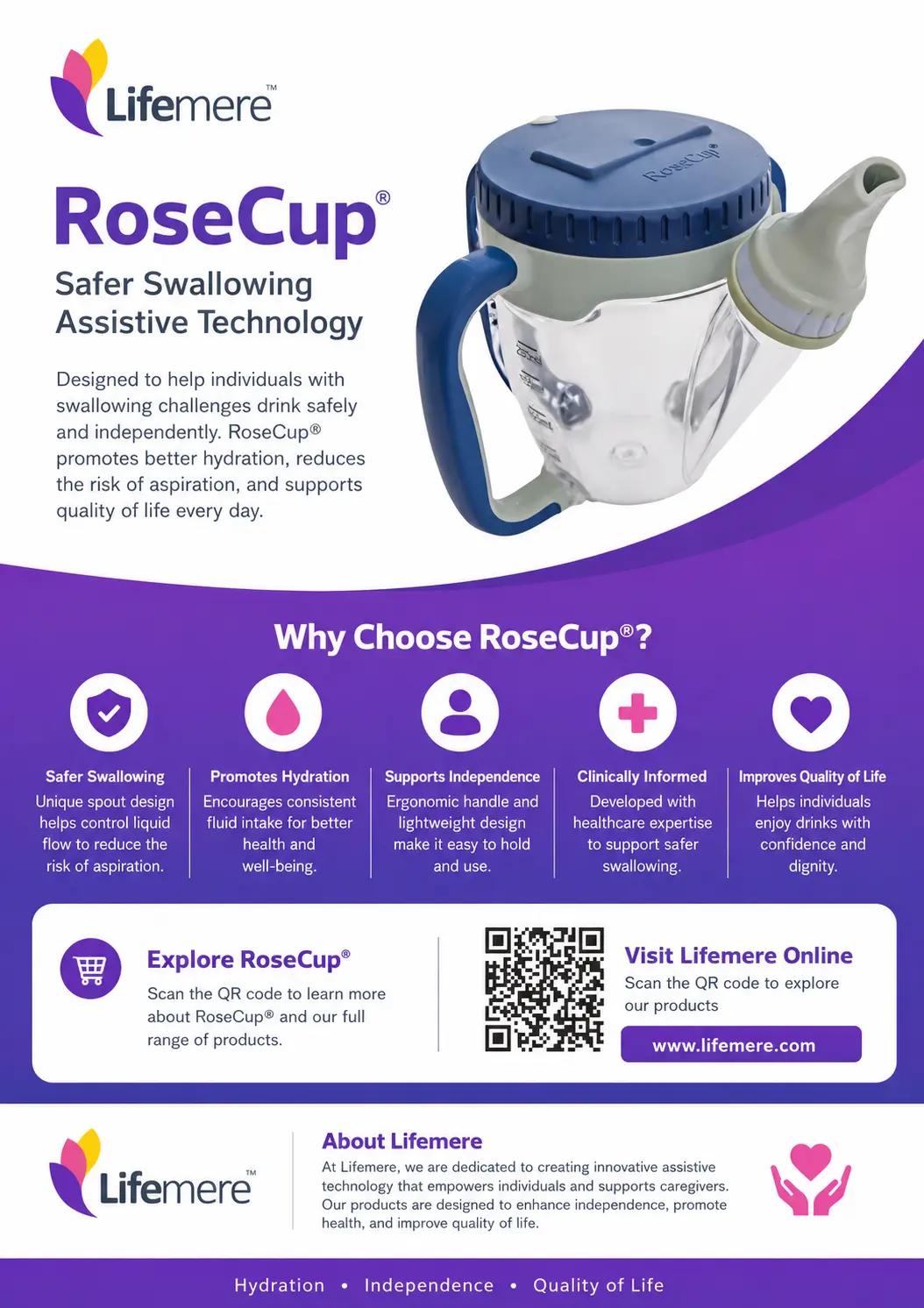
The RoseCup® System is a comprehensive adaptive intake system developed to support individuals living with dysphagia, neurological disorders, motor impairments, and medically complex conditions that affect safe and efficient drinking.
Unlike conventional adaptive cups designed around a single feature, the RoseCup® System incorporates interchangeable attachments that allow clinicians to individualize drinking based on a person's swallowing profile, functional abilities, and changing clinical needs.
The system is designed to support more controlled fluid intake while promoting independence and dignity across multiple care settings.
Importantly, the RoseCup® System is intended to complement, not replace, comprehensive dysphagia assessment and individualized management provided by qualified healthcare professionals.
Clinical Features That May Help Support Functional Drinking
Configurable Flow Control
Flow regulation is a fundamental component of dysphagia management.
The RoseCup® System offers configurable attachments that may help support more controlled liquid delivery according to individual swallowing recommendations.
Volume Control
When used with the Soft Spout attachment, the system delivers approximately 3 mL of thickened liquid per suck cycle.
This controlled delivery encourages paced drinking and helps prevent continuous flow, which may help support safer oral intake for appropriately selected individuals.
Support Across IDDSI Levels
The RoseCup® System is compatible with thickened liquids prescribed under the International Dysphagia Diet Standardisation Initiative (IDDSI) Framework, including IDDSI Levels 1 through 4, as recommended by the treating Speech-Language Pathologist.
Lifemere was proud to serve as a 2025 sponsor of IDDSI, supporting global implementation of the IDDSI Framework and Flow Test as part of a shared commitment to improving dysphagia care worldwide. International Dysphagia Diet Standardisation Initiative (IDDSI) International Dysphagia Diet Standardisation Initiative (IDDSI)
Reduced Need for Excessive Head Tilt
Many individuals with neurological disorders experience reduced cervical mobility or postural instability. The RoseCup® System is designed to minimize the need for excessive head extension during drinking, which may improve comfort and support more functional drinking positions.
Supporting Independence
Large ergonomic handles, a stable base, and multiple drinking attachments may help support independent drinking for individuals living with tremor, weakness, reduced dexterity, or impaired upper extremity control.
The system can also be used effectively during caregiver-assisted feeding.
Clinical Applications Across Neurological Populations
Speech-Language Pathologists frequently encounter patients whose swallowing challenges evolve over time.
The RoseCup® System may be considered for individuals living with:
- Parkinson's disease
- Alzheimer's disease and related dementias
- ALS
- stroke
- traumatic brain injury
- multiple sclerosis
- cerebral palsy
- frailty and sarcopenia
- head and neck cancer
- medically complex aging
Across these populations, clinicians often aim to preserve hydration, nutritional intake, medication access, participation, and quality of life while adapting to changing functional abilities.
Adaptive intake technologies may help support these broader clinical goals within interdisciplinary management plans.
Supporting Person-Centered Care
Modern rehabilitation increasingly emphasizes participation alongside impairment reduction.
The World Health Organization's International Classification of Functioning, Disability and Health (ICF) encourages clinicians to evaluate activity, participation, and environmental factors in addition to body structure and function.
Within dysphagia management, this means asking not only whether swallowing is physiologically safer, but also whether individuals can successfully implement recommendations in everyday life.
Adaptive intake systems represent one practical strategy for helping bridge this gap.
Clinical Credibility
The RoseCup® System reflects Lifemere's commitment to evidence-informed innovation in dysphagia management.
Key milestones include:
- Registered as a Class I Medical Device with the Australian Therapeutic Goods Administration (TGA), meeting the requirements of the Therapeutic Goods Act 1989 and the Therapeutic Goods (Medical Devices) Regulations 2002.
- Preferred supplier for Australian Health and Aged Care (AHAC), supporting expanded access to dysphagia solutions across Australia's healthcare and aged care sectors.
- Proud 2025 sponsor of IDDSI, championing worldwide adoption of standardized texture modification and the IDDSI Flow Test.
These milestones reflect Lifemere's ongoing commitment to supporting clinicians with practical, evidence-informed solutions that complement comprehensive dysphagia management.
Learn more about the RoseCup® System: https://www.lifemere.com/education/the-rosecup-system
Looking Ahead
As dysphagia care continues to evolve, clinicians have an opportunity to expand the conversation beyond aspiration prevention alone.
Hydration, medication management, self-feeding independence, caregiver efficiency, participation, and quality of life are equally important clinical outcomes that influence long-term health and well-being.
Adaptive intake systems such as the RoseCup® System may help support these broader goals by providing practical tools that assist individuals in translating clinical recommendations into meaningful daily function.
A Call to Clinicians
As healthcare professionals, we routinely educate patients on swallowing exercises, compensatory strategies, and dietary modifications. Equally important is ensuring they have the practical tools needed to carry those recommendations into everyday life.
If you work with individuals living with dysphagia, consider sharing information about the RoseCup® System with your patients and caregivers. Expanding awareness of adaptive intake technologies may help support hydration, independence, confidence, and participation long after therapy has ended.
References
Cosentino G, Avenali M, Schindler A, et al. A multinational consensus on dysphagia in Parkinson's disease: screening, diagnosis and prognostic value. Journal of Neurology. 2022. https://link.springer.com/article/10.1007/s00415-021-10739-8
International Dysphagia Diet Standardisation Initiative (IDDSI). https://iddsi.org
World Health Organization. International Classification of Functioning, Disability and Health (ICF). https://www.who.int/standards/classifications/international-classification-of-functioning-disability-and-health
Lifemere. The RoseCup® System. https://www.lifemere.com/education/the-rosecup-system
Jessica Ackerman, MS,CCC-SLP, is a Speech-Language Pathologist and dysphagia specialist with more than 25 years of experience in swallowing disorders, neurological rehabilitation, digital health, and healthcare innovation. As a clinical consultant to Lifemere, she is passionate about advancing person-centered dysphagia care through education, innovation, and practical solutions that support hydration, participation, independence, and quality of life.
Link to relevant articles:
- International MS Day 2026: Why Swallowing Health Deserves Greater Attention in Multiple Sclerosis Care
- Dysphagia Management Beyond Diet Modification: Reframing Clinical Goals Toward Hydration, Participation, and Quality of Life
- Alzheimer's & Brain Awareness Month: Dysphagia, Hydration, and the Hidden Burden of Swallowing Dysfunction in Dementia Care
- ALS Global Awareness Day: Dysphagia, Hydration, and Preserving Quality of Life in Amyotrophic Lateral Sclerosis
The science of texture-modified foods and thickened
liquids has reached a point of excellence under the
leadership of the IDDSI (International Dysphagia Diet
Standardisation Initiative). The considerable efficiency
gap that remains in managing Dysphagia
lies in intake devices.
More than 10 companies worldwide manufacture intake
devices, but in some care sectors, more than 90% of
patients still use spoons and open cups!
Professionals and carers need education and training,
and the industry needs guidelines, research, and
stimulation to improve the design of intake devices.

Congratulations to the IDDSI launching for the first time in
Europe with its inaugural congress in Florence, Italy, on
February 27-28, 2025. It represents a significant milestone
in enhancing the quality of care for individuals with
swallowing difficulties in Europe.

Dr Gabriel Roux will represent Lifemere in Florencе.
Contact: gawie@lifemere.com or phone: +61 428 406 684
Frequently Asked Questions

-- / 5 average rating from -- reviews
We'd love to hear your thoughts!
Lorem ipsum dolor sit amet, consectetur adipiscing elit. Suspendisse varius enim in eros elementum tristique. Duis cursus, mi quis viverra ornare, eros dolor interdum nulla, ut commodo diam libero vitae erat. Aenean faucibus nibh et justo cursus id rutrum lorem imperdiet. Nunc ut sem vitae risus tristique posuere.
We'd love to hear your thoughts!
-- / 5 average rating from -- reviews
Lorem ipsum dolor sit amet, consectetur adipiscing elit. Suspendisse varius enim in eros elementum tristique. Duis cursus, mi quis viverra ornare, eros dolor interdum nulla, ut commodo diam libero vitae erat. Aenean faucibus nibh et justo cursus id rutrum lorem imperdiet. Nunc ut sem vitae risus tristique posuere. uis cursus, mi quis viverra ornare, eros dolor interdum nulla, ut commodo diam libero vitae era