
Everyday Movement, Dignified Drinking, and the Difference Thoughtful Design Can Make
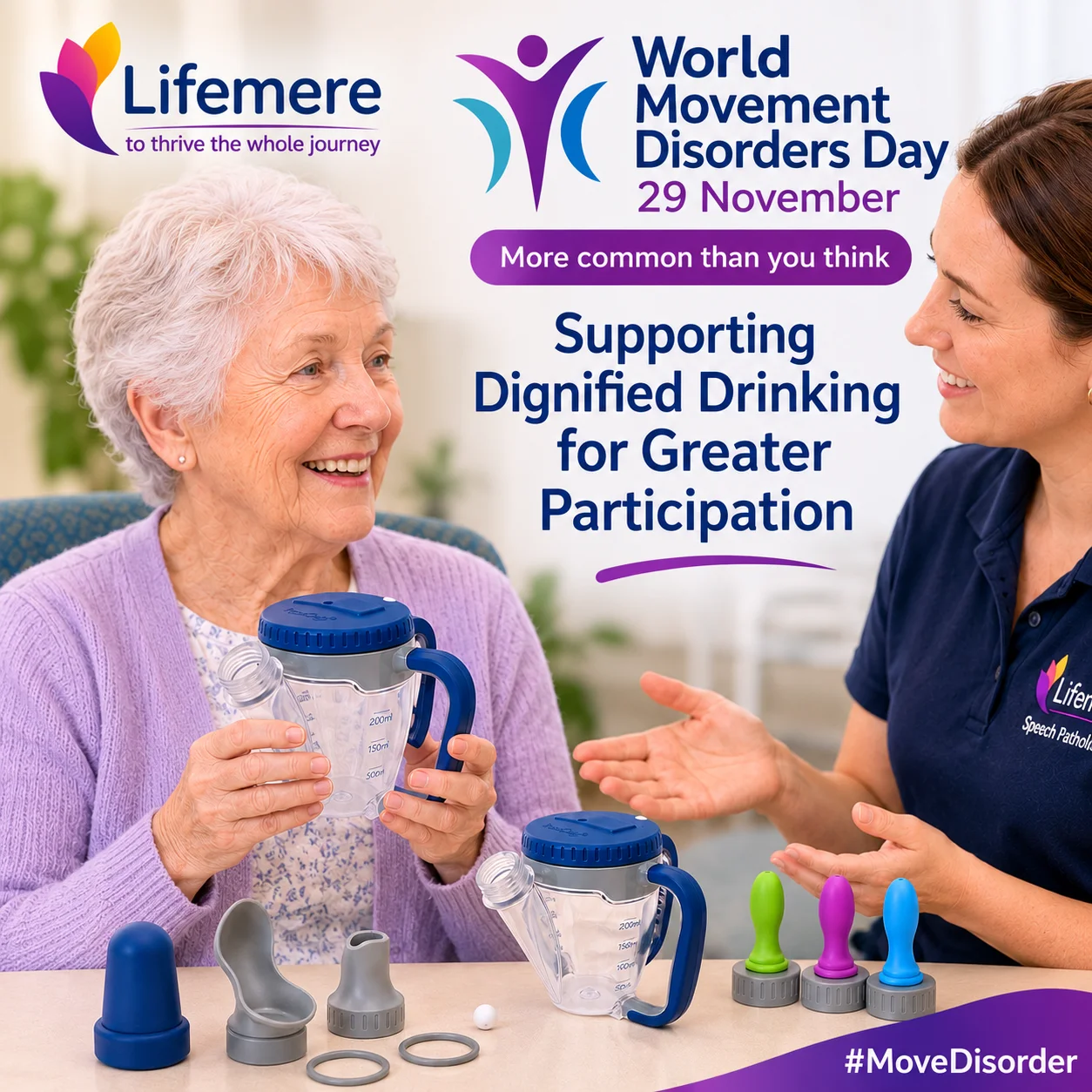
World Movement Disorders Day: 29 November
Key Clinical Takeaways
- Movement disorders can affect more than walking and mobility. Tremor, bradykinesia, rigidity, dystonia, and impaired coordination may also influence everyday activities such as reaching for, holding, and drinking from a cup.
- Drinking is a functional activity involving motor control, positioning, coordination, and access to an appropriate drinking method.
- Small design features, including accessible handles, a stable base, controlled delivery options, and reduced need for head extension, may help support individual drinking needs.
- Assistive drinking equipment should be selected in collaboration with the person and their healthcare team, with consideration of swallowing function, motor ability, posture, preferences, and clinical recommendations.
More Common Than You Think
Movement disorders are often understood through their most visible features: tremor, involuntary movement, stiffness, or changes in walking. Yet their impact can extend into many of the ordinary activities that shape a person's day.
The International Parkinson and Movement Disorder Society's 2026 World Movement Disorders Day campaign, “More common than you think,” encourages greater awareness of the breadth of the movement disorder community and the lived experiences of people affected.
World Movement Disorders Day is observed annually on 29 November. The campaign invites people to share information, stories, and resources using #MoveDisorder. Explore the official campaign resources, including videos, graphics, and educational materials:
World Movement Disorders Day: Get Involved
Movement disorders encompass a broad range of neurological conditions, including Parkinson's disease, dystonia, tremor disorders, ataxia, Huntington's disease, and other conditions that may affect the control, initiation, or coordination of movement. Their manifestations vary considerably between individuals and may change over time.
For some people, the effect is not limited to major mobility tasks. It may be experienced in the small, repeated actions of everyday life.
When Everyday Activities Require More Effort
Parkinson's disease provides a familiar example. Bradykinesia, rigidity, and tremor can influence the speed, precision, and stability of movement. Depending on the individual's presentation, these motor features may make activities such as dressing, preparing a meal, handling utensils, or drinking from a conventional cup more demanding.
Other movement disorders may present with different functional challenges. Dystonia can involve involuntary muscle contractions or abnormal postures. Ataxia may affect coordination and the accuracy of movement. Tremor may interfere with maintaining a steady grasp or controlling an object during use.
These experiences are not universal. A person living with Parkinson's disease, for example, may have little difficulty drinking independently, while another person may find the same activity increasingly effortful. The clinical significance lies in understanding the individual's functional experience rather than assuming that a diagnosis predicts a particular level of ability.
Drinking is a particularly important everyday activity because it involves repeated coordination of several actions:
- Reaching for and grasping a drinking vessel
- Stabilising the cup while lifting and moving it
- Maintaining a comfortable and functional position
- Coordinating the movement of the cup with oral intake
- Managing the effort required to repeat the task throughout the day
When one or more of these actions becomes difficult, the experience of drinking may require additional time, concentration, assistance, or adaptation.
The Importance of Small, Thoughtful Design Details
Assistive technology is often most meaningful when it responds to a specific functional need without unnecessarily adding complexity. For someone experiencing tremor, reduced grip strength, or impaired motor control, the shape and stability of a drinking vessel may matter. For another person, the angle of the drinking outlet, the amount of effort required to access a drink, or the ability to use a preferred attachment may be more relevant.
These details are not simply product features. They are part of the relationship between a person, their environment, and the activity they wish to perform.
Thoughtful design may help support:
Access and grasp: Handles designed to accommodate different hand positions and levels of grip ability may provide alternative ways to hold and use a cup.
Stability: A stable base and an accessible form may help reduce some of the handling demands associated with conventional drinking vessels.
Positioning: A drinking outlet designed to reduce the need for head extension may support a more comfortable drinking position for some individuals.
Individual choice: Adaptable attachments can provide options for different functional needs, preferences, and clinical recommendations.
Participation and dignity: When a drinking method is better matched to a person's abilities, it may help support participation in everyday hydration and mealtime activities, with assistance where needed.
The aim is not to suggest that a device can remove the effects of a neurological condition. Rather, it is to recognise that the design of everyday objects can influence how accessible an activity feels and how much support may be required.
RoseCup® System: Designed Around Individual Drinking Needs
Developed and manufactured in Queensland, Australia, the RoseCup® System reflects Lifemere's commitment to thoughtful design for people who experience difficulties with drinking, feeding, or swallowing. The RoseCup® System is an adaptive drinking system designed to support access to fluids and nutrition for individuals with a range of functional needs. Its design includes features such as easy-to-grip handles, an angled drinking outlet, and a selection of attachments that provide different ways to access and manage liquid delivery.
For some people living with movement disorders, these features may be relevant to the practical challenges of drinking. The handles may offer alternative grasp options for individuals experiencing tremor or reduced grip. The angled outlet is designed to minimise the need for head extension. Attachment selection allows the drinking method to be considered in relation to individual abilities and preferences.
The RoseCup® System is registered as a Class 1 Medical Device with Australia's Therapeutic Goods Administration. Learn more about the design and available attachments:
The RoseCup® System | Lifemere
The RoseCup® System does not prevent aspiration, eliminate swallowing risk, or replace an individual swallowing assessment, clinical management, or appropriate supervision. Selection and use should be guided by the person's needs and the recommendations of their healthcare team, particularly when dysphagia is present.
Queensland Disability Action Week: Preparing for Inclusion
This year, World Movement Disorders Day falls on the final day of Queensland Disability Action Week, which runs from 22 to 29 November 2026. Queensland Disability Action Week promotes access, inclusion, and recognition of the contributions of people with disability. Its 2026 theme, “Ready together: Preparing for every need, in every emergency,” highlights the importance of working collectively to ensure that people have the support and access they need.
For Lifemere, this week carries particular significance. Queensland is the home of the RoseCup® System, where its inventors live and where it is manufactured.
The connection between Disability Action Week and World Movement Disorders Day offers an opportunity to reflect on accessibility in everyday life. Inclusion is not only about major public spaces or services. It is also about the everyday environments and objects that enable people to participate in activities that matter to them.
A drinking vessel may seem like a small detail. For someone who finds drinking physically demanding, however, the right design may be an important part of making that activity more accessible.
A Shared Commitment to Dignified Drinking
World Movement Disorders Day reminds us that movement disorders are more common than many people realise, and that their effects can be experienced in ways that are not always visible to others.
For healthcare professionals, this is an invitation to consider the functional consequences of movement disorders beyond diagnosis and symptom management. For designers and assistive technology providers, it is an opportunity to continue listening to the people who use their products and to develop solutions that respond to individual needs.
For families, carers, and people living with movement disorders, it is a reminder that everyday activities deserve attention, respect, and thoughtful support.
At Lifemere, we believe that dignity is found in the details. A well-considered design may help support a person's ability to participate in drinking and hydration with greater choice, comfort, and independence, whether independently or with assistance.
May the benefits of the RoseCup® System continue to reach those who need it most.
This World Movement Disorders Day, let's make everyday accessibility part of the conversation.
Share the official campaign using #MoveDisorder and help raise awareness of the diverse experiences of people living with movement disorders.
Jessica Ackerman, MS,CCC-SLP, is a Speech-Language Pathologist and dysphagia specialist with more than 25 years of experience in swallowing disorders, neurological rehabilitation, digital health, and healthcare innovation. As a clinical consultant to Lifemere, she is passionate about advancing person-centered dysphagia care through education, innovation, and practical solutions that support hydration, participation, independence, and quality of life.+
Link to relevant articles:
The science of texture-modified foods and thickened
liquids has reached a point of excellence under the
leadership of the IDDSI (International Dysphagia Diet
Standardisation Initiative). The considerable efficiency
gap that remains in managing Dysphagia
lies in intake devices.
More than 10 companies worldwide manufacture intake
devices, but in some care sectors, more than 90% of
patients still use spoons and open cups!
Professionals and carers need education and training,
and the industry needs guidelines, research, and
stimulation to improve the design of intake devices.

Congratulations to the IDDSI launching for the first time in
Europe with its inaugural congress in Florence, Italy, on
February 27-28, 2025. It represents a significant milestone
in enhancing the quality of care for individuals with
swallowing difficulties in Europe.

Dr Gabriel Roux will represent Lifemere in Florencе.
Contact: gawie@lifemere.com or phone: +61 428 406 684
Frequently Asked Questions

-- / 5 average rating from -- reviews
We'd love to hear your thoughts!
Lorem ipsum dolor sit amet, consectetur adipiscing elit. Suspendisse varius enim in eros elementum tristique. Duis cursus, mi quis viverra ornare, eros dolor interdum nulla, ut commodo diam libero vitae erat. Aenean faucibus nibh et justo cursus id rutrum lorem imperdiet. Nunc ut sem vitae risus tristique posuere.
We'd love to hear your thoughts!
-- / 5 average rating from -- reviews
Lorem ipsum dolor sit amet, consectetur adipiscing elit. Suspendisse varius enim in eros elementum tristique. Duis cursus, mi quis viverra ornare, eros dolor interdum nulla, ut commodo diam libero vitae erat. Aenean faucibus nibh et justo cursus id rutrum lorem imperdiet. Nunc ut sem vitae risus tristique posuere. uis cursus, mi quis viverra ornare, eros dolor interdum nulla, ut commodo diam libero vitae era