
Disability Pride Month: Advancing Accessible Hydration and Person-Centered Participation in Dysphagia Care
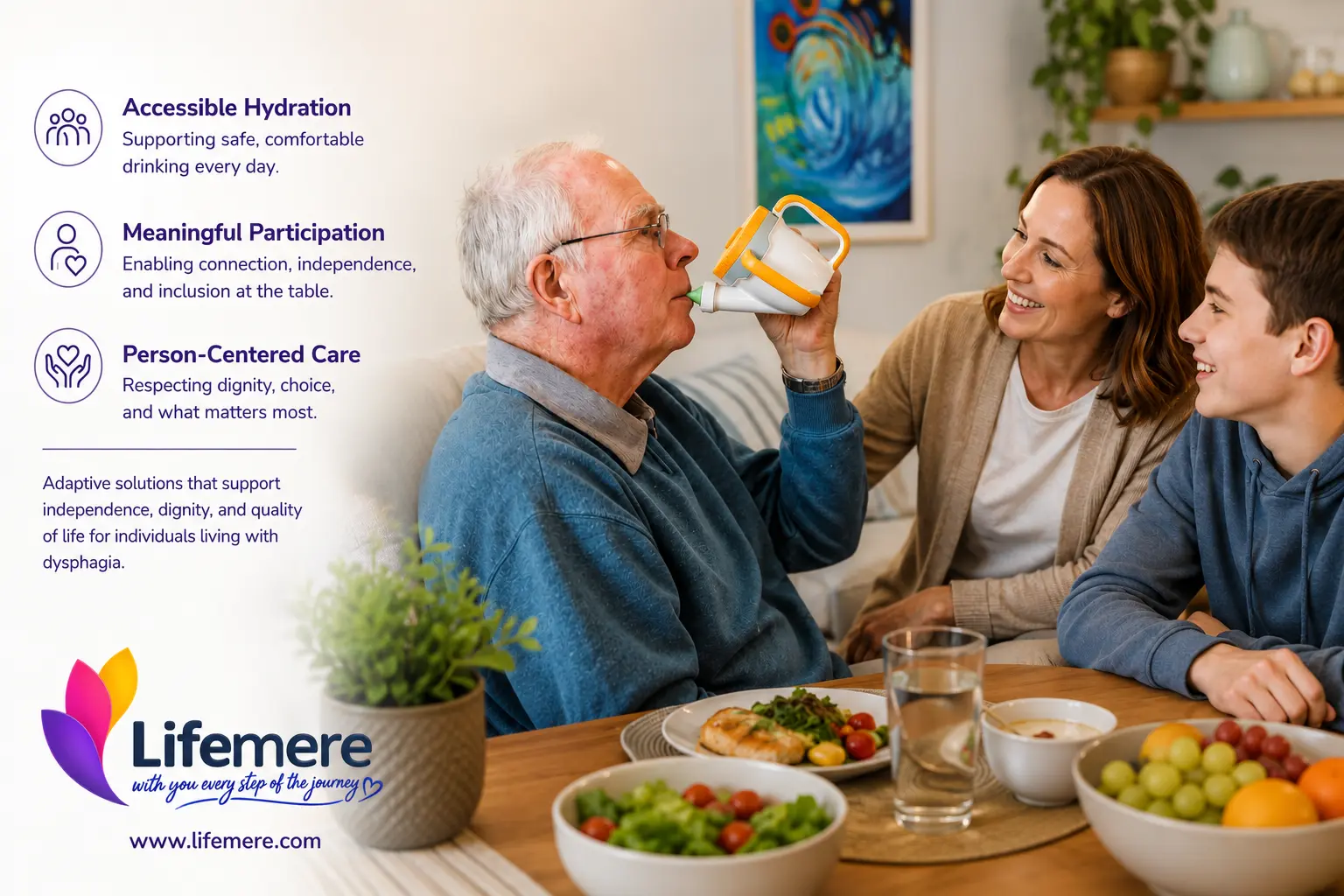
Disability Pride Month serves as an opportunity to recognize disability not as something to be overcome, but as an integral part of human diversity. For healthcare professionals, it also provides an important reminder that high-quality care extends beyond diagnosing impairment and reducing risk. It requires creating environments, interventions, and technologies that support accessibility, autonomy, participation, and dignity.
For Speech-Language Pathologists, neurologists, primary care physicians, GPs, rehabilitation professionals, nurses, and interdisciplinary healthcare teams, this perspective has particular relevance in dysphagia management.
Historically, dysphagia care has focused appropriately on aspiration prevention, nutritional management, and physiologic swallowing rehabilitation. While these priorities remain fundamental, contemporary models of disability and rehabilitation increasingly recognize that functional participation is an equally important clinical outcome.
The question is no longer simply, "Can this individual swallow safely?"
It is increasingly, "Can this individual participate safely, independently, and confidently in one of life's most meaningful occupations: eating and drinking?"
The International Shift Toward Participation-Based Care
Over the past two decades, rehabilitation has undergone a significant philosophical evolution. Guided by the World Health Organization International Classification of Functioning, Disability and Health (ICF), clinicians are encouraged to evaluate health conditions not only through impairment, but also through activity, participation, environmental factors, and quality of life.
Within dysphagia management, this shift encourages clinicians to consider questions beyond instrumental swallowing findings.
- How easily can a person access fluids throughout the day?
- Can they independently bring a cup to their mouth?
- Does the effort required to drink discourage adequate hydration?
- Are caregivers able to safely assist with oral intake?
- Does the person's drinking method support social participation during meals?
These functional considerations often determine long-term outcomes just as much as physiologic swallowing impairment. Reference World Health Organization. International Classification of Functioning, Disability and Health (ICF).
Accessibility Is a Clinical Intervention
Accessibility is frequently discussed in relation to architecture, transportation, and communication.
Less frequently discussed is accessibility during eating and drinking.
For individuals living with Parkinson's disease, Alzheimer's disease, ALS, stroke, cerebral palsy, multiple sclerosis, traumatic brain injury, muscular dystrophy, and age-related frailty, barriers to eating and drinking often extend well beyond swallowing physiology.
Clinical challenges commonly include:
- impaired upper extremity coordination
- tremor
- weakness
- reduced grip strength
- fatigue
- limited cervical mobility
- poor postural control
- reduced oral motor coordination
- caregiver dependence
When these barriers are addressed through adaptive equipment, clinicians are often supporting much more than swallowing safety. They are supporting participation, confidence, autonomy, and self-determination.
Assistive Technology Deserves a Larger Role in Dysphagia Management
Despite significant advances in instrumental assessment and rehabilitation, assistive technology remains comparatively underrepresented within dysphagia literature and clinical guidelines. Yet adaptive technologies frequently bridge the gap between successful clinical recommendations and successful implementation at home.
The Australian Royal Commission into Aged Care Quality and Safety recognized the importance of adaptive equipment in supporting safe, dignified oral intake, recommending improved access to allied health services and adaptive equipment that promotes independence while reducing caregiver burden.
Similarly, the Australian Aged Care Quality Standards emphasize individualized care that supports function, dignity, and choice.
These recommendations reinforce an important principle: Successful dysphagia management depends not only on clinical expertise but also on providing practical tools that individuals can incorporate into everyday life.
From Risk Reduction to Participation
Adaptive intake systems should not be viewed simply as drinking aids.
They represent one component of a broader person-centered management strategy that may help support implementation of individualized swallowing recommendations across multiple care settings.
The RoseCup® System is a comprehensive adaptive intake system designed to support more controlled fluid intake for individuals living with dysphagia, neurological conditions, motor impairments, and age-related swallowing changes.
Its configurable design is intended to help support:
- controlled bolus delivery
- individualized flow regulation
- compatibility with IDDSI Levels 1 through 4, as recommended by the treating Speech-Language Pathologist
- reduced need for excessive head tilt
- improved drinking stability
- self-feeding independence
- caregiver efficiency
- hydration opportunities
- participation during meals and social activities
Importantly, the RoseCup® System is not intended to replace comprehensive dysphagia assessment or intervention. Rather, it represents one practical tool that may help support accessibility and functional implementation of evidence-based clinical recommendations.
Measuring Outcomes That Matter
As healthcare increasingly embraces person-centered care, clinicians are expanding the outcomes they measure.
In addition to aspiration events, instrumental findings, and nutritional markers, healthcare teams are increasingly evaluating:
- hydration status
- meal participation
- independence
- caregiver burden
- adherence to recommendations
- satisfaction with oral intake
- health-related quality of life
These outcomes align closely with the values celebrated during Disability Pride Month, recognizing that meaningful participation is a clinical outcome worthy of equal consideration.
Looking Forward
Disability Pride Month reminds us that healthcare should strive not only to reduce impairment, but also to remove unnecessary barriers to participation. For individuals living with dysphagia, maintaining the ability to eat and drink safely, comfortably, and with dignity remains one of the most meaningful forms of participation in everyday life.
As clinicians continue advancing evidence-based dysphagia management, integrating accessibility, assistive technology, and person-centered outcomes into routine clinical practice may help redefine success, not simply by preventing complications, but by enabling people to live fuller, more independent lives.
References
- World Health Organization. International Classification of Functioning, Disability and Health (ICF). https://www.who.int/standards/classifications/international-classification-of-functioning-disability-and-health
- Australian Royal Commission into Aged Care Quality and Safety. Final Report: Care, Dignity and Respect. https://agedcare.royalcommission.gov.au/
- Cichero JAY, Lam P, Steele CM, et al. Development of International Terminology and Definitions for Texture-Modified Foods and Thickened Fluids Used in Dysphagia Management. Dysphagia. 2017. https://link.springer.com/article/10.1007/s00455-016-9758-y
- Miller N, et al. Living With Dysphagia: Health-Related Quality of Life and Participation Outcomes. Dysphagia. https://link.springer.com/journal/455
Jessica Ackerman, MS,CCC-SLP, is a Speech-Language Pathologist and dysphagia specialist with more than 25 years of experience in swallowing disorders, neurological rehabilitation, digital health, and healthcare innovation. As a clinical consultant to Lifemere, she is passionate about advancing person-centered dysphagia care through education, innovation, and practical solutions that support hydration, participation, independence, and quality of life.
Link to relevant articles:
- International MS Day 2026: Why Swallowing Health Deserves Greater Attention in Multiple Sclerosis Care
- Alzheimer's & Brain Awareness Month: Dysphagia, Hydration, and the Hidden Burden of Swallowing Dysfunction in Dementia Care
- ALS Global Awareness Day: Dysphagia, Hydration, and Preserving Quality of Life in Amyotrophic Lateral Sclerosis
The science of texture-modified foods and thickened
liquids has reached a point of excellence under the
leadership of the IDDSI (International Dysphagia Diet
Standardisation Initiative). The considerable efficiency
gap that remains in managing Dysphagia
lies in intake devices.
More than 10 companies worldwide manufacture intake
devices, but in some care sectors, more than 90% of
patients still use spoons and open cups!
Professionals and carers need education and training,
and the industry needs guidelines, research, and
stimulation to improve the design of intake devices.

Congratulations to the IDDSI launching for the first time in
Europe with its inaugural congress in Florence, Italy, on
February 27-28, 2025. It represents a significant milestone
in enhancing the quality of care for individuals with
swallowing difficulties in Europe.

Dr Gabriel Roux will represent Lifemere in Florencе.
Contact: gawie@lifemere.com or phone: +61 428 406 684
Frequently Asked Questions

-- / 5 average rating from -- reviews
We'd love to hear your thoughts!
Lorem ipsum dolor sit amet, consectetur adipiscing elit. Suspendisse varius enim in eros elementum tristique. Duis cursus, mi quis viverra ornare, eros dolor interdum nulla, ut commodo diam libero vitae erat. Aenean faucibus nibh et justo cursus id rutrum lorem imperdiet. Nunc ut sem vitae risus tristique posuere.
We'd love to hear your thoughts!
-- / 5 average rating from -- reviews
Lorem ipsum dolor sit amet, consectetur adipiscing elit. Suspendisse varius enim in eros elementum tristique. Duis cursus, mi quis viverra ornare, eros dolor interdum nulla, ut commodo diam libero vitae erat. Aenean faucibus nibh et justo cursus id rutrum lorem imperdiet. Nunc ut sem vitae risus tristique posuere. uis cursus, mi quis viverra ornare, eros dolor interdum nulla, ut commodo diam libero vitae era