
National Hydration Day: Reframing Hydration as a Functional Outcome in Dysphagia and Neurological Care
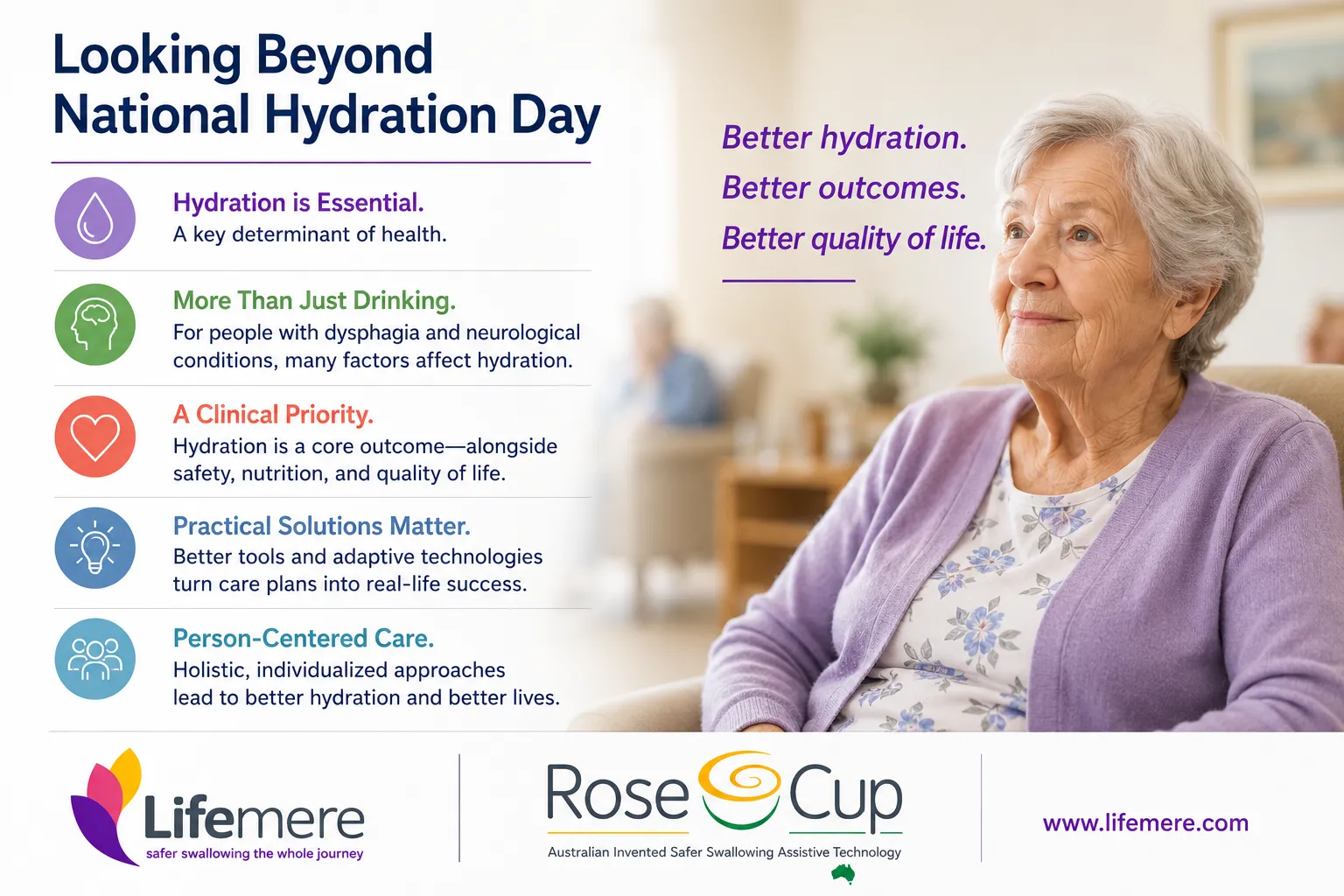
Although June 23 is officially observed as National Hydration Day in the United States, it serves as a powerful reminder of a global health challenge: the millions of people worldwide living with swallowing difficulties (dysphagia), for whom maintaining safe hydration is an everyday struggle. While hydration is frequently discussed within wellness and preventive health contexts, it remains one of the most overlooked clinical outcomes in dysphagia management and neurological care.
For Speech-Language Pathologists, neurologists, primary care physicians, geriatricians, rehabilitation professionals, and interdisciplinary care teams, hydration status influences far more than fluid balance alone. Adequate hydration affects cognition, medication effectiveness, rehabilitation participation, pulmonary health, bowel function, cardiovascular stability, nutritional status, and quality of life. Yet for many individuals living with dysphagia, Parkinson's disease, Alzheimer's disease, ALS, stroke, and age-related frailty, associated dysphagia can make maintaining adequate hydration an ongoing daily challenge.
As National Hydration Day recently highlighted the importance of drinking enough fluids, it also provided an opportunity to examine a more nuanced clinical question: Are healthcare providers paying enough attention to the functional barriers that prevent individuals with dysphagia from achieving adequate hydration in the first place?
Hydration Is a Clinical Outcome, Not Simply a Wellness Metric
Historically, dysphagia management has centered heavily on aspiration prevention, airway protection, and texture modification. While these remain essential clinical priorities, growing evidence suggests hydration deserves equal attention within comprehensive swallowing management.
The recently updated ESPEN Guideline on Nutrition and Hydration in Dementia (2024) emphasized that dehydration remains a major contributor to adverse clinical outcomes among older adults and individuals living with neurodegenerative disease. Source: Volkert D, et al. ESPEN Guideline on Nutrition and Hydration in Dementia: 2024 Update
Similarly, a 2024 review in Nutrients highlighted the significant relationship between hydration status, frailty, cognitive function, hospitalization risk, and quality of life among aging populations. Source: Hooper L, et al. Hydration and Healthy Ageing: Current Evidence and Future Directions
These findings reinforce an important reality: dehydration is not merely a symptom. It is often a driver of declining health outcomes.
Why Individuals With Dysphagia Frequently Struggle to Maintain Adequate Hydration
The causes of dehydration in dysphagia populations are multifactorial.
Dehydration among people living with dysphagia is rarely caused by a single factor. Rather, it reflects the cumulative impact of physical, neurological, cognitive, and environmental barriers. Patients commonly experience:
- fear of choking during drinking
- reduced drinking efficiency
- fatigue during intake
- prolonged mealtimes
- upper extremity weakness
- tremor or impaired motor control
- reduced self-feeding ability
- cognitive impairment
- poor adherence to modified liquid recommendations
- limited access to appropriate drinking supports
Importantly, these challenges are not confined to advanced disease.
Even individuals with relatively mild swallowing impairment may consciously reduce fluid intake because drinking becomes physically difficult, socially frustrating, or excessively time-consuming.
Research continues to demonstrate that individuals prescribed thickened liquids often consume significantly less fluid than recommended, increasing risk for dehydration and associated complications. Source: Murray J, Doeltgen S, Miller M, Scholten I. Does a Water Protocol Improve the Hydration and Health Status of Individuals with Thin Liquid Aspiration Following Stroke? A Systematic Review. Dysphagia. 2022.
For many patients, hydration challenges arise not solely from swallowing physiology but from the cumulative burden associated with drinking itself.
Beyond Aspiration: The Functional Barriers to Drinking
One of the most important shifts occurring within contemporary dysphagia practice is the growing recognition that successful swallowing management extends beyond aspiration prevention.
Clinicians increasingly recognize that patients may remain technically safe while simultaneously experiencing:
- inadequate hydration
- reduced oral intake efficiency
- medication administration difficulties
- caregiver dependence
- reduced participation in social meals
- declining confidence during eating and drinking
These functional barriers often have substantial consequences for health outcomes. A 2025 study examining dysphagia and nutritional outcomes in Parkinson's disease demonstrated significant associations between oral phase dysfunction, reduced meal performance, and increased malnutrition risk, reinforcing the importance of examining swallowing through a broader functional lens. Source: Mozzanica F, et al. Tongue Strength, Endurance, Swallowing Efficiency, and Nutritional Risk in Parkinson's Disease. Dysphagia. 2025.
The implications extend beyond Parkinson's disease and are relevant across many neurological populations.
Bridging the Gap Between Clinical Recommendations and Real-World Implementation
One of the greatest challenges in dysphagia care is not identifying swallowing impairment. It is successfully implementing recommendations in everyday life. Speech-Language Pathologists routinely provide evidence-based recommendations regarding positioning, pacing, liquid modifications, compensatory strategies, and swallowing techniques. However, translating these recommendations into sustainable daily behaviors remains difficult for many individuals.
Hydration frequently becomes the first casualty of this implementation gap.
The ability to independently access fluids, regulate drinking pace, manage bolus size, and comfortably consume beverages throughout the day may be just as important as the recommendations themselves.
The Emerging Role of Adaptive Intake Systems
As person-centered dysphagia management continues to evolve, adaptive intake technologies are gaining increased attention as practical tools that may help support hydration and functional participation. Unlike traditional drinking vessels, adaptive intake systems are specifically designed to address common barriers that interfere with successful drinking.
The RoseCup® System represents one example of this evolving category of assistive technology. Designed as a comprehensive adaptive intake system, the RoseCup® System incorporates configurable flow-control options, multiple handle configurations, drinking supports, and interchangeable components intended to support a wide range of swallowing, neurological, motor control, and upper extremity impairments.
For individuals experiencing dysphagia-related drinking challenges, the RoseCup® System may help support:
- more controlled bolus delivery
- improved drinking stability
- hydration opportunities throughout the day
- self-feeding access
- caregiver efficiency
- adherence to individualized swallowing recommendations
- person-centered participation during meals and social activities
Importantly, adaptive intake systems are not intended to replace clinical evaluation or treatment. Rather, they may help support accessibility and implementation of swallowing recommendations in the environments where patients actually live, eat, drink, and participate.
Looking Beyond National Hydration Day
National Hydration Day served as an important reminder that hydration remains one of the most fundamental determinants of health. For individuals living with dysphagia and neurological disease, however, hydration is rarely as simple as being told to drink more water. Successful hydration depends upon swallowing function, physical ability, cognition, caregiver support, environmental access, and practical drinking solutions.
As dysphagia management continues to evolve toward more person-centered and functional models of care, hydration deserves recognition as a primary clinical outcome alongside aspiration prevention, nutritional status, and quality of life.
Future advances in dysphagia care will likely require not only better assessment and intervention, but also greater attention to the practical tools and adaptive technologies that may help individuals successfully implement clinical recommendations in everyday life.
Jessica Ackerman, MS,CCC-SLP, is a Speech-Language Pathologist and dysphagia specialist with more than 25 years of experience in swallowing disorders, neurological rehabilitation, digital health, and healthcare innovation. As a clinical consultant to Lifemere, she is passionate about advancing person-centered dysphagia care through education, innovation, and practical solutions that support hydration, participation, independence, and quality of life.
Link to relevant articles:
- Dysphagia Management Beyond Diet Modification: Reframing Clinical Goals Toward Hydration, Participation, and Quality of Life
- National Dysphagia Awareness Month: Moving Beyond Diet Modification Toward Functional Hydration, Adherence, and Participation Outcomes
- Alzheimer's & Brain Awareness Month: Dysphagia, Hydration, and the Hidden Burden of Swallowing Dysfunction in Dementia Care
- ALS Global Awareness Day: Dysphagia, Hydration, and Preserving Quality of Life in Amyotrophic Lateral Sclerosis
The science of texture-modified foods and thickened
liquids has reached a point of excellence under the
leadership of the IDDSI (International Dysphagia Diet
Standardisation Initiative). The considerable efficiency
gap that remains in managing Dysphagia
lies in intake devices.
More than 10 companies worldwide manufacture intake
devices, but in some care sectors, more than 90% of
patients still use spoons and open cups!
Professionals and carers need education and training,
and the industry needs guidelines, research, and
stimulation to improve the design of intake devices.

Congratulations to the IDDSI launching for the first time in
Europe with its inaugural congress in Florence, Italy, on
February 27-28, 2025. It represents a significant milestone
in enhancing the quality of care for individuals with
swallowing difficulties in Europe.

Dr Gabriel Roux will represent Lifemere in Florencе.
Contact: gawie@lifemere.com or phone: +61 428 406 684
Frequently Asked Questions

-- / 5 average rating from -- reviews
We'd love to hear your thoughts!
Lorem ipsum dolor sit amet, consectetur adipiscing elit. Suspendisse varius enim in eros elementum tristique. Duis cursus, mi quis viverra ornare, eros dolor interdum nulla, ut commodo diam libero vitae erat. Aenean faucibus nibh et justo cursus id rutrum lorem imperdiet. Nunc ut sem vitae risus tristique posuere.
We'd love to hear your thoughts!
-- / 5 average rating from -- reviews
Lorem ipsum dolor sit amet, consectetur adipiscing elit. Suspendisse varius enim in eros elementum tristique. Duis cursus, mi quis viverra ornare, eros dolor interdum nulla, ut commodo diam libero vitae erat. Aenean faucibus nibh et justo cursus id rutrum lorem imperdiet. Nunc ut sem vitae risus tristique posuere. uis cursus, mi quis viverra ornare, eros dolor interdum nulla, ut commodo diam libero vitae era